

MTB Wheels NZ: The Complete New Zealand Buyer's Guide
- by Nigel
-

You're probably here because your current wheels are telling you something. Maybe the rear rim has a fresh flat spot after a rocky descent in Nelson. Maybe your stock hub feels lazy on technical climbs. Maybe you've gone tubeless, fitted better tyres, sorted your suspension, and the bike still feels vague in corners and harsh through chatter.
That's usually the point where riders start looking at MTB wheels in NZ and get buried in product listings. Carbon. Alloy. Boost. XD. Microspline. Hookless. Enduro rated. E-bike ready. Half the listings assume you already know what all of it means, and the other half are trying to sell you the lightest thing on the page.
Here's the blunt version. Wheel choice should match how and where you ride in New Zealand. Not what looked good in a review. Not what a pro runs overseas. Not what your mate bought for one dry bike park trip. If you ride rough, wet, rooty, rock-strewn trails, you need a stronger build than the average marketing blurb suggests. If you race XC, you can get away with lighter gear. If you ride an e-MTB, stop pretending a feathery race wheel is a smart buy.
Why Your MTB Wheels Matter More Than You Think
A rider rolls into the workshop with a bike that's mostly sorted. Decent fork. Good tyres. Brakes bled. Drivetrain quiet. But the bike still feels dead in some corners, nervous in others, and it pings off square edges instead of tracking cleanly. Nine times out of ten, the wheels are part of the story.
Wheels do more than hold tyres. They shape how the bike carries speed, how it settles into rough ground, and how much abuse it can take before something gives up. When a rim is too narrow for the tyre, the sidewalls squirm. When a wheel build is too light for the rider or terrain, spokes lose tension and the bike starts feeling imprecise long before anything fully breaks.
A wheel upgrade changes more than speed
The common mistake is thinking wheels are just a weight upgrade. They're not. They affect:
- Tyre support: Rim width changes how your tyre sits and grips.
- Ride feel: A stiff wheel tracks differently from a more forgiving one.
- Reliability: Better spoke tension and stronger rims mean fewer workshop visits.
- Compatibility: Axles, rotor mounts, freehub bodies, and tyre clearance all need to line up.
Practical rule: If your riding regularly includes rocks, roots, square edges, or jumps, durability matters more than shaving a few grams.
There's also a New Zealand-specific angle. Mountain biking here didn't grow as a tiny niche. It became mainstream fast. A historical review from BikeNZ notes bicycle imports rose from 96,180 in 1988 to 194,974 in 1993, and the Bicycle Industry Association of New Zealand estimated 80% of all bicycles sold in New Zealand were mountain-bicycle style during that period, which helps explain why MTB standards became central to the local market rather than a side category (BikeNZ history of cycling in New Zealand).
The smartest buy usually isn't the lightest buy
If you're a lighter XC rider on smoother trails, sure, go lighter. Everyone else should be more suspicious. A wheelset that looks impressive on paper can be a terrible fit for South Island rock strikes, North Island roots, and the extra mass of modern trail bikes and e-bikes.
Buy for the riding you do. Not the riding you imagine when you're staring at spec sheets late at night.
Wheel Sizes and Rim Profiles Explained
Wheel size arguments get silly fast, so here's the mechanic's version.
26-inch still exists on older bikes and a few specialist builds, but for most riders shopping MTB wheels in NZ today, it's yesterday's standard. 27.5-inch is still a good call if you want a lively feel, easier body movement on tighter tracks, or you're on a smaller frame. 29-inch has become the default for a reason. It carries speed better, smooths rough ground more effectively, and suits the kind of mixed trail riding many Kiwi riders do.
What each wheel size feels like on trail
26 is quick and twitchy.
27.5 is balanced.
29 is calmer and faster once the trail gets rough.
For aggressive trail and enduro bikes, mullet setups have a real place. That usually means 29 front and 27.5 rear. You get the rollover and front-end confidence of a 29er, plus a bit more clearance and manoeuvrability at the back.
That setup isn't universally accepted in racing though. New Zealand MTB regulations state bikes in MTBNZ-sanctioned events must have equal wheel diameters, except in downhill and enduro, where unequal wheel diameters are permitted (MTBNZ technical regulations version 2.4). If you race, check before you buy.
Rim width matters more than most riders think
Modern tyre performance depends heavily on internal rim width. That number affects sidewall support, tyre shape, and how stable the bike feels when cornering hard or running lower pressure.
| Wheel Size | Typical Internal Rim Width | Best Suited To | Trade-offs |
|---|---|---|---|
| 26-inch | narrower legacy widths to mid-width modern options | Older bikes, dirt jump, some youth and specialist builds | Limited future-proofing, fewer modern options |
| 27.5-inch | about 25mm to 35mm | Trail, enduro, smaller riders, playful builds | Gives up some rollover compared with 29 |
| 29-inch | about 25mm to 35mm | XC, trail, marathon, modern all-round use | Can feel less nimble in very tight terrain |
| Mullet | front and rear widths chosen by use case | Enduro, gravity, steep technical riding | Frame, fork, and discipline compatibility must be checked carefully |
For a rough guide, 25mm to 28mm suits many XC tyres well. Around 30mm is a strong all-round trail choice. Wider again suits heavier casings, aggressive tyres, and riders who want more support.
If you're still sorting tyre choice alongside wheel choice, this guide to MTB tyres in NZ is worth reading because tyre casing and tread need to match the rim, not fight it.
Hooked, hookless, and clearance
Don't overcomplicate rim profiles. Most riders need to know three things:
- Hooked rims are familiar and broadly tyre-friendly.
- Hookless rims need closer attention to tyre compatibility.
- Clearance matters twice. Check frame clearance and fork clearance before you chase wider rims and bigger volume tyres.
A lot of riders obsess over diameter and ignore width. On modern mountain bikes, width often changes ride quality more than the badge on the wheel.
Hub, Axle, Rotor, and Freehub Standards
This is where expensive mistakes happen. A wheelset can be excellent and still be wrong for your bike.
The biggest compatibility headache in MTB wheels NZ isn't usually rim choice. It's standards. Local product pages show Boost hubs, 29-inch wheelsets, and different freehub bodies everywhere, but they often don't answer the simple question riders have, which is whether the wheel will fit the bike and drivetrain without extra parts. That's a real gap in local buying guidance, especially around Boost spacing and driver-body differences such as XD and MicroSpline (Trek New Zealand mountain bike wheel listings).
Start with axle spacing
If your bike is fairly modern, there's a good chance it uses Boost spacing. Older bikes may not.
| Standard | Measurement / Type | Common Use | Key Compatibility Note |
|---|---|---|---|
| Front QR | quick release legacy standard | Older XC and entry-level bikes | Won't fit modern thru-axle forks |
| Front thru-axle | 15mm or 20mm | Trail, enduro, DH | Fork must match axle diameter and hub width |
| Rear QR | older quick release standard | Older hardtails and trail bikes | Not interchangeable with thru-axle rear hubs |
| Rear 12x142 | thru-axle | Earlier modern MTB standard | Similar appearance to Boost, but not the same |
| Rear 12x148 Boost | thru-axle | Most current trail and enduro bikes | Check frame spacing before ordering |
| Front Boost | 110mm | Common on newer forks | Hub must match fork spacing |
| Rear Boost | 148mm | Common on newer frames | Cassette line and frame spacing depend on it |
If that table makes you want to measure everything twice, good. You should.
Rotor mount and freehub body matter just as much
Rotor fit is simple in theory and annoying in practice. Most MTB hubs use either 6-bolt or Centerlock. Neither is better for most riders. What matters is matching what you already own, unless you're happy buying new rotors or adapters.
Freehub bodies are where people really trip up. Common ones include:
- Shimano HG: common on many older and mid-range setups
- MicroSpline: needed for some modern Shimano cassettes
- SRAM XD: used with many SRAM MTB cassettes
- XDR: more common in drop-bar worlds, but it still appears in mixed builds
Buy the wheel first without confirming the freehub, and you can easily turn a simple upgrade into a parts chase.
Competition rules also shape some wheel choices
In New Zealand youth and school racing, equipment rules still matter. Cycling New Zealand's school rules require a minimum of 16 spokes per wheel, rim depth no greater than 55 mm, and disc wheels are not permitted (Cycling New Zealand Schools Rules).
That's aimed more at school competition than trail riding, but it shows a broader local preference for durable, standardised equipment rather than weird edge-case gear.
The short compatibility checklist
Before you buy any wheelset, confirm:
- Front hub spacing and axle type
- Rear hub spacing and axle type
- Rotor mount type
- Freehub body
- Wheel diameter
- Tyre clearance for the rim and tyre combo
If you can't answer those six points, you're not ready to click buy.
Spokes, Hubs, and How Strong a Build Do You Need
A lot of riders obsess over rim material and ignore the build. Bad move. Spokes and hub quality decide whether a wheel stays true, holds tension, and survives repeated hits.
If you're comparing MTB wheels in NZ, don't just count engagement points and call it done. Ask how the wheel is built, what spoke count it uses, and whether replacement parts are easy to get.
Spoke count is not a vanity number
Lower spoke counts can work well for lighter riders and smoother use. They also leave you less margin when the trail gets ugly.
| Build | Spoke Count | Lacing | Best For |
|---|---|---|---|
| Lightweight XC | 24 | usually lower-cross patterns depending on hub and rim | Racing, lighter riders, smoother lines |
| Light trail | 28 | commonly 2-cross or similar | Fast trail use, balanced weight and support |
| All-round trail and enduro | 32 | often 3-cross | Most riders, rougher terrain, better repair practicality |
| Heavy-duty gravity and e-MTB | 36 | strong crossing pattern | High impacts, heavier riders, loaded bikes |
For most riders, 32 spokes is a sensible place to land. It's not glamorous. It's just reliable.
Hub feel matters, but serviceability matters more
Fast-engaging hubs feel great on technical climbs and awkward ratcheting moves. That part is real. But don't get blinded by the click noise and marketing. Bearings wear. Freehubs need service. Driver bodies get chewed. Spare parts matter.
J-bend spokes are still a practical choice because they're easier to replace and widely available. Straight-pull can work well, but it's less forgiving when you need parts in a hurry. Brass nipples usually make more sense than alloy nipples for riders who value longevity over tiny weight savings.
If your current wheel is already bent, this guide on fixing a buckled bike wheel helps you work out whether a repair is sensible or whether you're throwing good money at a tired build.
Heavier riders, e-bike riders, and anyone riding rocky lines regularly should stop shopping like an XC racer.
My blunt recommendation
- XC and lighter riders: lower spoke counts can be fine
- Trail riders: 28 or 32 is usually the smart zone
- Enduro, jump, park, e-MTB: 32 minimum is a safer bet
- Big hitter or heavier rider: look hard at stronger rims and a build that can be serviced easily
A fancy rim laced into a weak build is still a weak wheel.
Tubeless Setup for NZ Trails
Tubeless isn't optional anymore for most mountain biking. If you're still running tubes on proper trail terrain, you're making life harder than it needs to be.
Lower pressures, better grip, fewer pinch flats, and improved control on rough ground are the reasons most riders switch. On loose surfaces, roots, and chopped-up descents, tubeless just makes more sense.
A clean setup process matters more than people think.
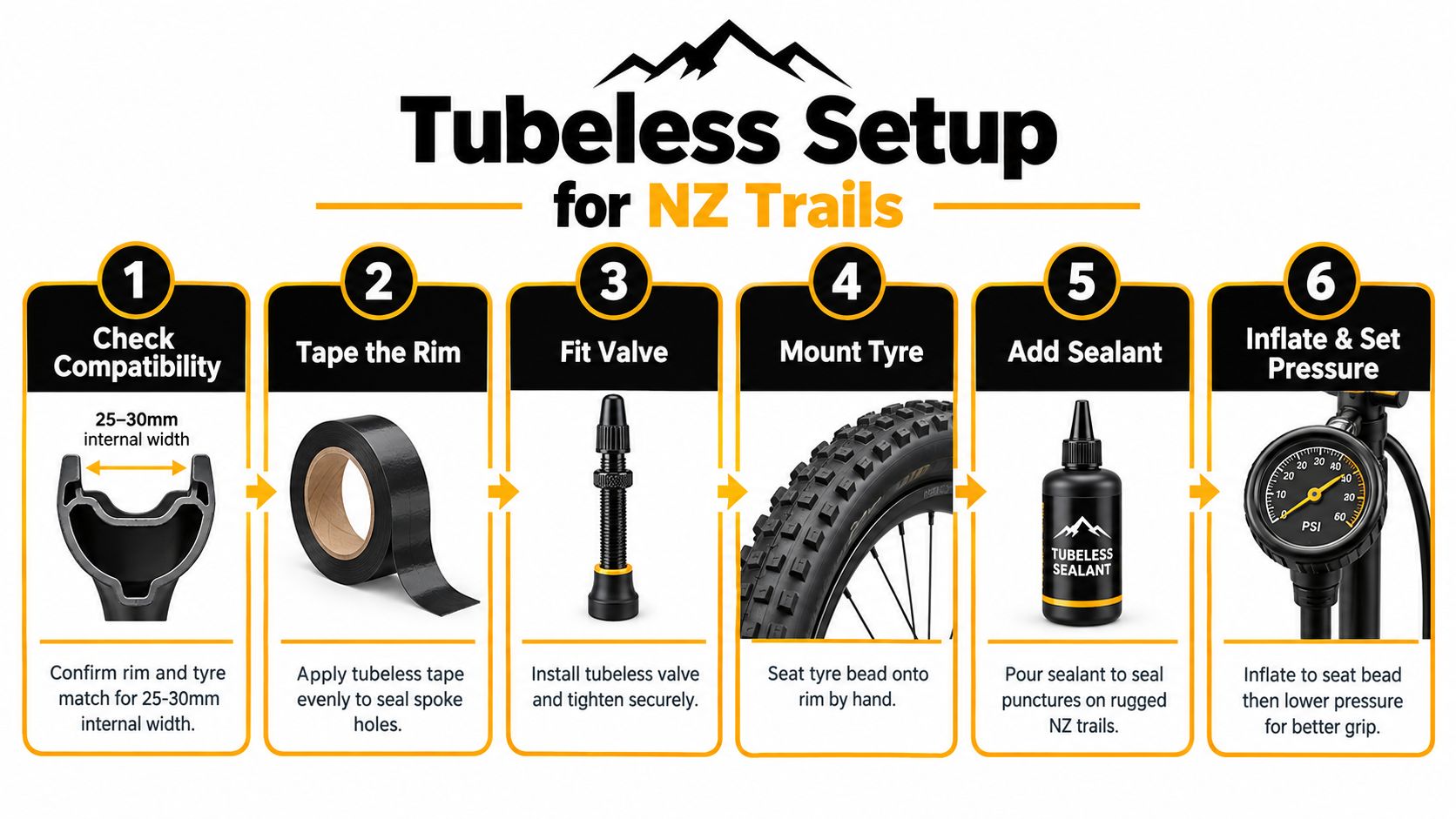
The basic setup that works
You need four things sorted before anything else:
- Compatible rim and tyre: Many modern MTB rims sit around 25 to 30mm internal width, and tyre shape needs to suit that range.
- Good tape job: Most tubeless failures start here.
- Proper valve fit: If the valve base doesn't seal cleanly, you'll chase leaks for no reason.
- Fresh sealant: Old sealant won't save you when the trail does what New Zealand trails do.
A decent step-by-step on how to set up tubeless tyres is handy if you're doing it at home and want fewer mistakes first time around.
Common mistakes I see in the workshop
The first is bad tape. The second is too little air volume when seating the bead. The third is riders assuming tubeless is fit-and-forget.
In New Zealand conditions, sealant maintenance matters because temperature swings and ride frequency change how quickly it dries out. Wet forest riding, dusty summers, thorny edges, and repeated impacts all expose lazy setups.
Here's a useful visual walkthrough before you start wrestling with beads and valves:
Discipline changes the setup
XC riders often want a lighter tyre and less drag. Trail riders need balance. Enduro and gravity riders usually benefit from tougher casings, stronger sidewall support, and in some cases inserts. E-MTB riders should be even more conservative because extra bike mass punishes weak tyre and rim setups quickly.
Workshop reality: Most tubeless problems aren't caused by the tyre. They come from poor tape, dried sealant, damaged rim beds, or pressures that are too optimistic for the rider and terrain.
Check pressure regularly. Refresh sealant on a sensible schedule. Inspect rims after hard hits. If the bike starts burping air in rough corners, don't just pump it up and hope.
Choosing Wheels by Riding Discipline and E-Bike Use
This is the part that matters. Forget broad marketing categories for a minute. Buy wheels for your riding discipline, your local terrain, and your body weight.
A lot of New Zealand search content still stops at product listings, even though local retail ranges clearly span lightweight XC wheels through to heavy-duty enduro and e-MTB options. What's usually missing is use-case advice that ties wheel choice to trail type, rider load, and real durability trade-offs (Specialized New Zealand mountain bike wheel range). That's the gap most riders need filled.
My recommendations by riding style
| Discipline | Wheel Size | Rim Internal Width | Approx Weight | Spoke Count |
|---|---|---|---|---|
| XC | 29-inch | 25 to 28mm | light | 24 to 28 |
| Trail | 27.5 or 29-inch | around 30mm | mid-weight | 28 to 32 |
| Enduro | 29 or mullet | 30 to 32mm | stronger build | 32 |
| Downhill | 27.5, 29, or mullet | wider heavy-duty profiles | heavy-duty | 32 to 36 |
| E-MTB | 27.5, 29, or mullet | about 30mm and up depending on tyre | reinforced | 32 to 36 |
XC and marathon
If you race XC or long-distance events, a lighter alloy or carbon wheel can make sense. Prioritise decent hub reliability and sensible tyre support over the absolute lowest weight. A super-light wheel that gets pushed around on rough descents is a false economy.
Trail riders
Most riders sit here. This category needs honesty more than hype. A 29er with around 30mm internal width is the safest all-round recommendation for a lot of NZ riders. If you want a more playful rear end or ride steep, tighter terrain, 27.5 still has a place.
Enduro and gravity
Mullet setups become useful, not just trendy. A 29-inch front with a 27.5 rear suits steep technical riding and bike park use if your frame allows it. Just remember the earlier rules point. Mixed wheels are accepted in downhill and enduro, not universally across all MTBNZ disciplines.
For nutrition on long race days and back-to-back uplift laps, this guide to science-backed cycling nutrition is useful. Better fuelling won't make a weak wheel stronger, but it will stop you making dumb line choices because you're running empty.
E-MTB riders need to stop underbuying
If you ride an e-bike, buy the stronger wheel. Don't talk yourself into a fragile wheelset because it looked trick online. The extra system weight, torque, and average trail speed are hard on rims, spokes, and freehubs. Reinforced rims, practical spoke counts, and durable hub internals are the smart play.
This is also the point where local workshop support matters. Rider 18 in Nelson is one of the shops that can help sort compatibility and servicing around MTB parts and wheel-related setup, which is useful when you're juggling e-bike standards, cassette fit, and rotor choices without wanting to guess.
Buying, Pricing, and Local Support in New Zealand
Let's talk money properly, because wheel shopping gets messy fast.
There are some realistic pricing bands in New Zealand, and pretending otherwise wastes time. Entry to mid-range alloy XC wheelsets usually sit around $600 to $1100 NZD. Trail alloy tends to land around $900 to $1500 NZD. Carbon trail and enduro wheelsets often run $1800 to $3500 NZD. Gravity-focused and premium downhill options can climb to $2500 to $5000+ NZD.
What those price bands usually mean
| Category | Alloy Range (NZD) | Carbon Range (NZD) | Typical Warranty | NZ Stock vs Indent |
|---|---|---|---|---|
| XC | $600 to $1100 | higher than alloy equivalents | brand-dependent | often easier to find in stock |
| Trail | $900 to $1500 | $1800 to $3500 | brand-dependent | mixed stock, popular sizes move fast |
| Enduro | around upper alloy trail pricing and above | commonly in the premium range | brand-dependent | some in stock, some indent |
| DH / Gravity | premium alloy and above | $2500 to $5000+ | brand-dependent | more limited locally |
| E-MTB rated | varies by build strength and hub spec | often premium if carbon | brand-dependent | compatibility often needs checking before purchase |
Those numbers don't tell the whole story. A cheaper wheelset with awkward warranty support or hard-to-source parts can cost more in the long run than a sensibly chosen local option.
Overseas buying isn't always the bargain it looks like
Ordering offshore can work. Sometimes it's the only way to get a niche hub or rim. But there are catches:
- Shipping adds up: International freight on wheels is bulky and rarely cheap.
- Returns are painful: Once a wheel has a cassette, rotor, tyre, or ride mark on it, change-of-mind returns usually get ugly.
- Warranty can drag: If something fails, sending photos and waiting for approvals is one thing. Shipping wheels back overseas is another.
- Small compatibility misses become expensive: Wrong freehub, wrong end caps, wrong rotor fit. All of that costs time and extra parts.
Why local support is worth paying for
For MTB wheels in NZ, local support is not fluff. It matters because wheel purchases often need a final check against the bike in front of you. Frame spacing, freehub fit, brake rotor reuse, tyre clearance, cassette choice, and whether the rider is hard on gear all affect the answer.
If you're buying through a local shop or workshop, ask them to confirm these five things before money changes hands:
- Hub standard
- Rotor mount
- Freehub body
- Spoke count and intended use
- Actual terrain the bike sees
That last one gets ignored too often. A rider who mostly pedals smooth loops needs something different from a rider who spends weekends smashing rock gardens and casing jumps.
The smartest buying move is usually simple. Stop trying to decode ten tabs of vague product pages and get a workshop to sanity-check the build before you order. That's especially true if you're mixing old frames, newer drivetrains, mullet ideas, or e-bike loads.
If your current wheels are bent, underbuilt, or just wrong for how you ride, Rider 18 can help sort the practical stuff before you waste money on an incompatible upgrade. They can advise on fit, service, and wheel-related component choices, whether you're replacing a tired stock wheelset or building something tougher for local terrain. Have a look at Rider 18 and start with the bike you ride, not the fantasy build in your head.


