

E Bikes for Sale NZ: How to Choose the Right Model
- by Nigel
-

Most buying advice for e-bikes for sale in NZ tells you to chase a bigger motor, a bigger battery and a higher top speed. That's the wrong order. I'd screen every listing by where you can legally ride it first, then by riding type, range and fit, and only then by price. A powerful bike you can't use on your local shared path or favourite track isn't an upgrade. It's an expensive restriction.
Motor Power and the 300 W Legal Line
A listing can look fast, light and well priced and still be the wrong machine for a shared path. Is this a bicycle, or is it a motor vehicle? That classification decides where you can ride, whether registration and a licence enter the picture, and whether a riverside path is open to you at all. Colour and suspension never fix a bike that sits on the wrong side of the line.
Under New Zealand Transport Agency (NZTA) rules, a New Zealand e-bike stays legally classified as a cycle rather than a motor vehicle only if its combined maximum motor output does not exceed 300 W. Cross that continuous output and you are looking at motor-vehicle treatment, not ordinary cycle access.
The Department of Conservation electric bikes guideline applies the same power split on public conservation land. E-bikes at or below 300 W may suit designated lower-grade cycling areas. Models above 300 W are treated as motorised vehicles and are generally limited to places where motor vehicles are already permitted.
Continuous power versus peak power
Sellers often headline peak power, the short burst a motor can produce for a few seconds. Continuous rated power is the output it can sustain, and that is the figure that belongs in the legal check. A large peak number with no continuous rating makes the motor look stronger while hiding the one number that decides access.
Battery voltage does not settle the question. Voltage describes the electrical system, not the motor's maximum output. Words like sport, off-road or high-performance say nothing about classification.
Motor output and what it means in New Zealand
| Motor output | Likely classification | Where you can usually ride |
|---|---|---|
| 300 W continuous or less | Cycle with pedal assistance | Shared paths, cycleways and lower-grade conservation tracks |
| Above 300 W continuous | Likely motor vehicle | Places where motor vehicles are allowed, with registration and licensing possibly required |
| Throttle-only assistance | Check classification before buying | Confirm the written classification before using shared paths or cycleways |
| Peak figure with no continuous rating | Ask the seller for the continuous rating | Don't assume cycle access until the seller confirms it in writing |
How to verify a listing
Work through four steps before you visit a shop or message a private seller.
- Find the continuous rating. Look for it on the specification sheet, the motor plate or the manufacturer's manual, not in the advertisement headline.
- Confirm how assistance works. Ask whether the motor assists only when you pedal, or whether a throttle drives the bike on its own.
- Get the classification in writing. Ask the seller to state, in an email or on the quote, that the model sits at or below the limit and counts as a cycle.
- Check your riding areas. Confirm the rules with your local council or the Department of Conservation for the paths and tracks you'll use.
Practical rule: More power can make a bike less useful, because a model above the line may lose access to the cycleways, shared paths and conservation tracks you bought it for.
Say you want an e-bike for a riverside shared path to work and weekend rides on a lower-grade conservation track. A model above the line fails both jobs, however strong it feels on a hill. A compliant commuter with modest continuous power does both jobs every day. I'd rather own the bike I can confidently ride than the one that wins a spec-sheet argument.
Reject any listing that can't state its continuous output. A seller who can't produce that figure can't tell you what you've bought, and you shouldn't carry the legal and access risk for them.
Which E-Bike Type Fits Your Riding
Once a bike passes the legal screen, match the type to the ride you'll do most weeks. Use this table as a lookup, then test your choice against weight, storage and carrying.
E-bike types by riding style
| Riding style | Best for | Typical range | Typical weight | Watch for |
|---|---|---|---|---|
| Commuter and city | Daily trips, racks and mudguards | 30 to 70 km | 20 to 26 kg | Built-in lights and rack mounts |
| Trail and mountain | Hills, rough tracks and shared trails | 40 to 80 km | 22 to 28 kg | Brakes, suspension and tyre grip |
| Cargo and family | Kids, shopping and heavy loads | 40 to 70 km | 28 to 40 kg | Load rating and stand strength |
| Folding and compact | Train or bus combinations and small storage | 30 to 60 km | 15 to 22 kg | Small wheels ride harsher |
| Gravel and fitness | Longer rides at road-style speed | 50 to 100 km | 18 to 24 kg | Gearing range and tyre clearance |
The range figures in the table are typical for each style under mixed assistance. Treat the conservative end as your planning number, because hills, loads and high assistance pull real distance down quickly.
A three-step way to choose
First, name your main ride in one sentence. "School drop-off, then 8 km to work" points to cargo or commuter. "Rail trail on Saturdays" points to trail or gravel. Vague answers like "a bit of everything" usually lead to a bike that's too heavy for town and too fragile for tracks.
Second, find that ride in the table and read across to the watch-out column. That's where ownership succeeds or fails. A commuter without rack mounts forces you into a sweaty backpack. A cargo bike with a weak stand becomes a daily wrestling match when it's loaded.
Third, check weight and battery against your storage and carrying limits. Measure the doorway, lift or car boot the bike must pass through. If you'll lift it onto a car rack, the table's weight range matters more than a small difference in motor feel.
The market gives you real choice across these types. Statistics New Zealand import data cited in the Ministry of Transport's Domestic Transport Costs and Charges Study shows electric-bicycle imports grew by approximately 100% in 2018 and a further 50% in 2019, and that across 2017 to 2019 e-bikes represented about 12% of all bicycles imported into New Zealand. That growth explains why commuter, recreational, cargo and mountain models now sit side by side in most ranges.
Don't buy across two rows hoping for the best of both. A folding bike won't gain trail grip from chunkier tyres, and a mountain bike won't become an easy train companion because you remove the front wheel. Choose one type, then write down the two specifications that matter most for it, such as weight and folded size for a compact bike, or load rating and stand strength for a cargo bike.
Battery Range and Real-World Distance
Battery range deserves a reality check before price comparisons. A removable battery makes charging at home or work easier, as this outdoor setup illustrates.
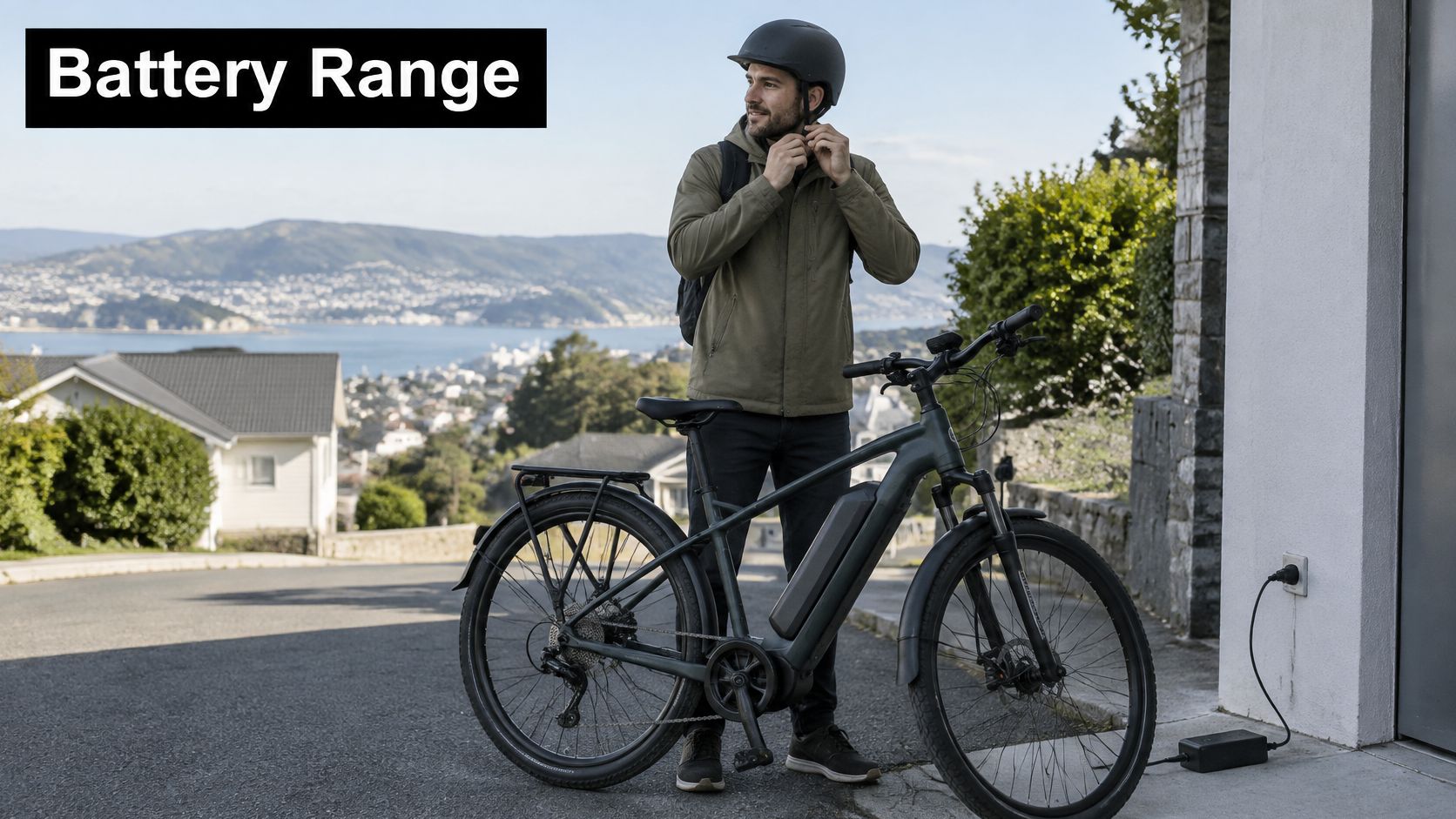
Watt-hours (Wh) measure battery capacity, much like the size of a fuel tank. How far that capacity takes you depends on how much assistance you use and where you ride. A large battery used at high assistance on steep hills can run down sooner than a smaller one ridden gently on flat ground. Wh alone cannot predict distance.
As a practical planning baseline, allow for approximately 20 to 40 km per charge, then check what conditions a listing's range estimate assumes. Ask about the assistance level and terrain, especially if the advertised distance is much greater.
What shortens your range
These factors commonly reduce range, roughly in order of impact:
- Highest assistance setting: Turbo or boost modes use battery power quickly, particularly when starting from a stop.
- Steep hills: Climbing demands sustained motor output, and descending rarely replaces the energy used.
- Rider and cargo weight: A child seat, panniers or shopping add work on climbs and at starts.
- Cold weather: A battery can provide less usable capacity on frosty mornings, which matters for winter commuting.
- Low tyre pressure: Soft tyres increase rolling resistance across the ride.
- Headwind: A steady coastal wind can make a flat route require continuous high assistance.
Estimate the battery you need
This video explains how assistance settings affect distance per charge.
Start with your longest regular round trip, then add 30 per cent for hills, cold and detours. Compare that total with the range available at the assistance level you expect to use. For a 24 km return commute, plan for about 31 km. If a bike reaches that distance only in its lowest assistance mode, it may not suit your daily ride.
Check the battery itself, too. Can you release it and carry it inside to charge? Is its weight manageable? Check the warranty length as part of comparing packs. The guide to how electric bike batteries work and wear explains charging habits that can help a battery last.
Match battery capacity to your longest regular ride, with a margin, rather than choosing the largest Wh figure on the listing. Extra capacity you do not use adds weight you carry each day.
Speed, Assistance and Safe Riding in NZ
The fastest e-bike in the shop is rarely the safest choice for commuting or family riding. Speed is easy to advertise and easy to overvalue. Control at low speed, in traffic and around pedestrians is what keeps you upright.
Auckland Transport's electric bikes page notes that some e-bikes provide assistance to 25 km/h, while others reach 32 km/h or more, so nominal motor wattage alone doesn't predict riding risk or path suitability. It also reflects NZTA advice to use low power on shared paths and ride at a speed consistent with other users, because e-bikes' greater mass and higher average speeds can increase crash likelihood and injury severity compared with conventional bicycles.
That reasoning is straightforward. A heavier bike travelling faster carries more energy into any collision, and it needs more distance to stop. On a shared path with dogs, children and people stepping off buses, your closing speed matters more than your cruising speed.
What to prioritise instead of top speed
For commuters and family riders, I'd rank these five qualities above any headline figure.
- Controllable, progressive assistance that starts gently rather than surging when you press a pedal at the lights.
- Brakes strong enough for a loaded bike on a wet descent, with pads and rotors in good condition.
- Front and rear lighting fitted and working for dusk commuting, not sold as an afterthought.
- A manageable total mass you can lift onto a car rack, wheel through a gate and hold upright on a slope.
- An assistance cut-off or speed setting you can change, so you can tame the bike for busy paths.
A bike that feels calm at walking pace will feel trustworthy in traffic. A bike that lunges at walking pace won't become calmer when a pedestrian steps out.
Test responsiveness in a quiet car park before you ride in traffic. Roll away slowly, notice how quickly assistance starts, then stop pedalling and notice how cleanly it stops. Try the same in the lowest and highest modes. Delayed cut-off feels minor in an empty car park and alarming when you're filtering toward a crossing.
Choose the assist speed and handling you can control in traffic, not the highest figure in the advertisement. You'll use the lower modes most days, so they need to feel smooth, predictable and easy to switch without looking down.
Pre-Purchase Checklist Before You Pay
Ask for the bike's specification sheet before you visit. A seller who'll send it in advance is giving you time to check the details without sales pressure, and a private seller who can't find any paperwork is telling you something useful.
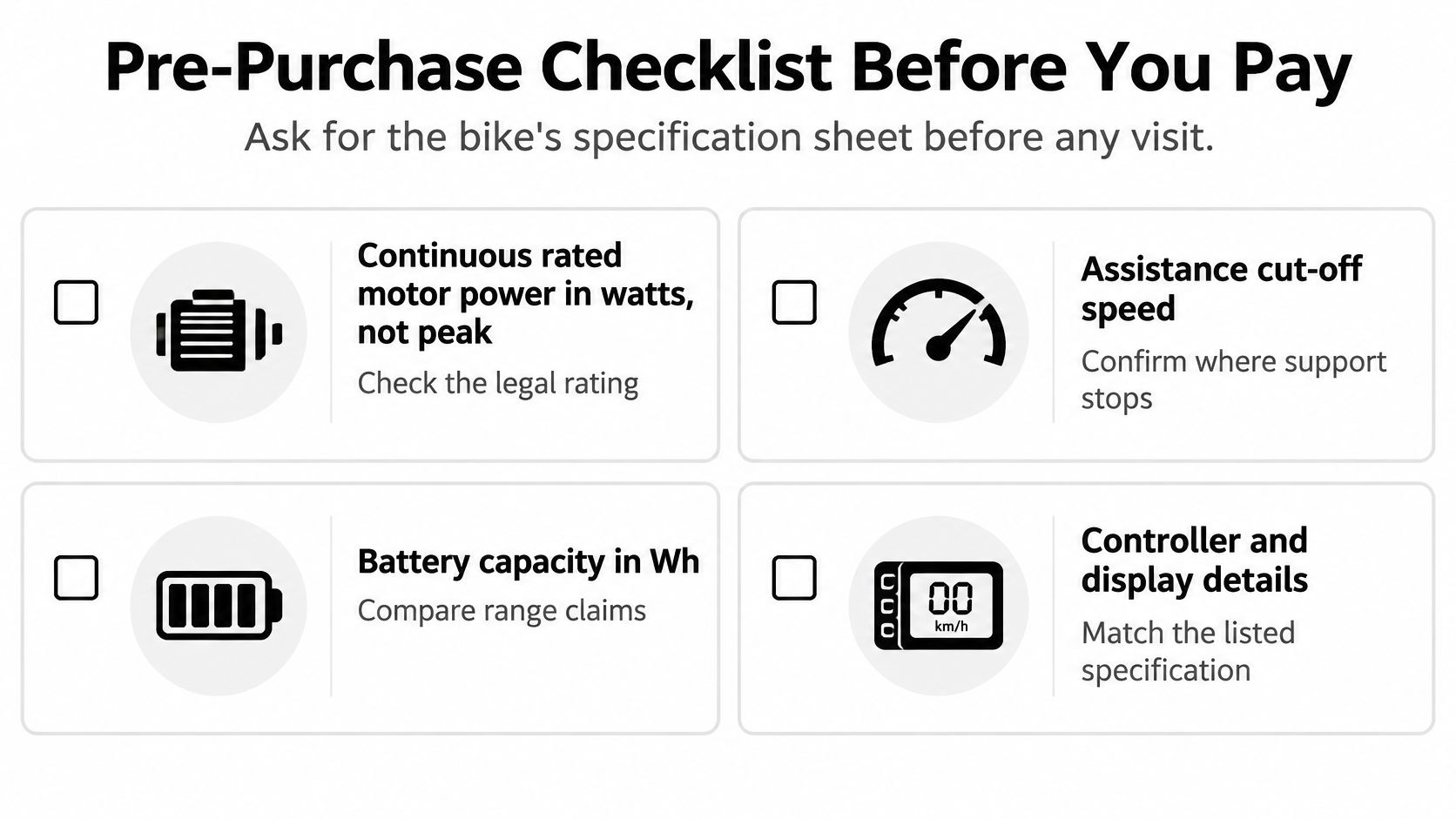
Eight answers to get in writing
- Continuous rated motor power in watts, not a peak figure.
- Assistance type, pedal-assist or throttle, and how each mode operates.
- Top assisted speed, and whether you or the shop can change that setting.
- Battery capacity in Wh, warranty length and replacement cost.
- Charger type, charging time and whether a spare battery is available for that model.
- Legal riding areas confirmed in writing by the seller.
- For used bikes, the serial number, service history and evidence of battery health, such as a diagnostic report or a full-charge range test.
- Delivery timeline and battery shipping method, including how the seller packs and handles the battery in transit.
Item 4 deserves care because the battery is part of the overall price. Ask the seller for the replacement figure now, while you can still walk away. An expensive proprietary pack can cost more over the bike's life than paying a higher purchase price for a model with a cheaper, readily available one. Comparing models against current e-bike prices in NZ helps you judge whether a low sticker price hides high ownership costs.
Item 8 matters because lithium batteries need careful transport. At Rider 18, e-bikes take 3 to 5 working days and are shipped with fully certified dangerous goods transport handling for battery compliance. Whatever seller you use, they should be able to describe their process just as plainly. Vague answers about couriers and packaging are a warning sign.
On a used bike, paperwork only tells half the story. Run your fingers over the chain, check for shark-tooth wear on chainrings and look for stiff links, and use this guide to spot drivetrain wear before you buy from SYCLR to judge whether the running gear has life left or needs money spent straight away.
Apply a simple pass rule. A bike makes your shortlist only if every item has a written answer. One missing answer on power, battery health or riding areas is enough to pause, because those gaps are where expensive surprises hide.
Save the checklist on your phone and use it on every visit, including private sales and ex-demo stock. Consistency protects you from the most common buying error, which is falling for the bike in front of you and dropping the questions you asked about the last one.
Test Riding and Fitting the Bike
Paperwork can't tell you whether a bike suits your body or your road. A model can pass every written check and still leave you with numb hands, a sore knee or a reach you can't hold for twenty minutes. Fit is where you find that out.
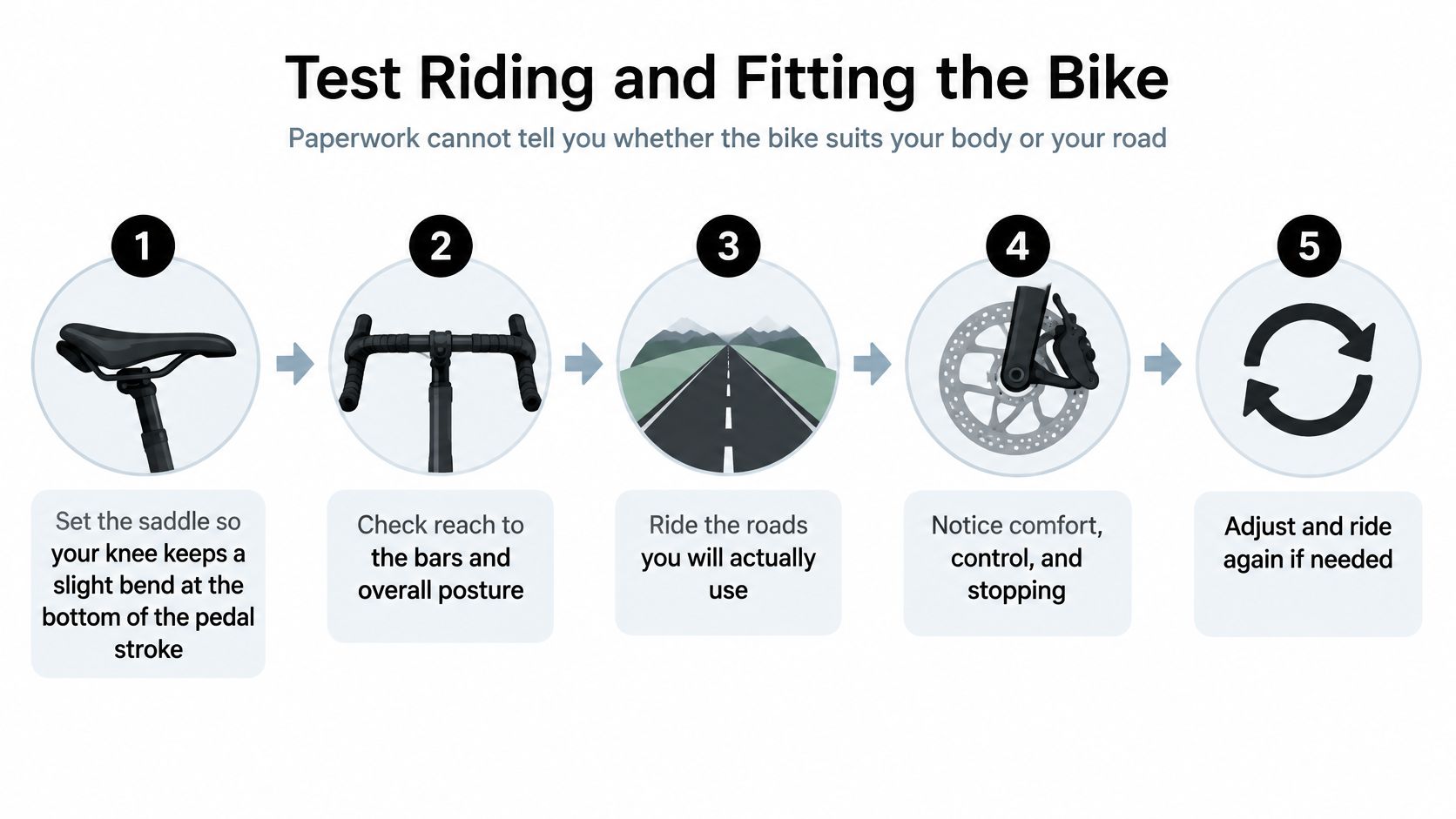
Six steps for a useful test ride
- Set the saddle height first. Your knee should keep a slight bend at the bottom of the pedal stroke, which protects the knee and lets you pedal smoothly instead of rocking your hips.
- Stand over the frame with both feet flat. Check your clearance over the top tube or step-through, because you'll need that room every time you stop at lights or on a cambered verge.
- Reach the grips, brake levers and shifter while seated. Wear your riding gloves if you use them. A common slip is accepting a stretched reach in the shop that you can't hold once your shoulders tire.
- Brake hard from walking speed, several times. Feel for lock-up, pulsing or fade. Many buyers only test in a straight line at gentle speed, then discover weak braking on their first loaded descent.
- Roll away at low assistance up a gentle slope or a dropped kerb. You're feeling how the power starts and where it cuts off, which shapes your confidence in slow traffic and on shared paths.
- Lift the bike onto a stand, a kerb or into your car. Test the weight you'll handle at home, not just the weight the motor hides while you're riding.
If you're between sizes, our bike frame size chart gives you a starting point, but treat it as a guide rather than a verdict. Two frames with the same nominal size can differ in reach and standover, and your torso and leg proportions decide which one works.
A good fit feels unremarkable. Power starts gently, brakes stop cleanly, your hands rest lightly on the grips and nothing aches after ten minutes.
Don't buy on a loop around the car park if your real riding includes a hill, a gravel section or a busy intersection. Ride the kind of surface you'll use weekly, turn at low speed, and stop and start a few times.
If you can't complete all six steps, arrange a second visit or a longer test ride. A seller who resists that request is asking you to gamble, and fit problems rarely improve after purchase.
Shortlist Your E-Bike Before You Buy
You're ready to shortlist when each candidate has passed the legal screen, matched your riding type and survived a test ride. Comparing three bikes in a structured way beats visiting six shops and relying on memory.
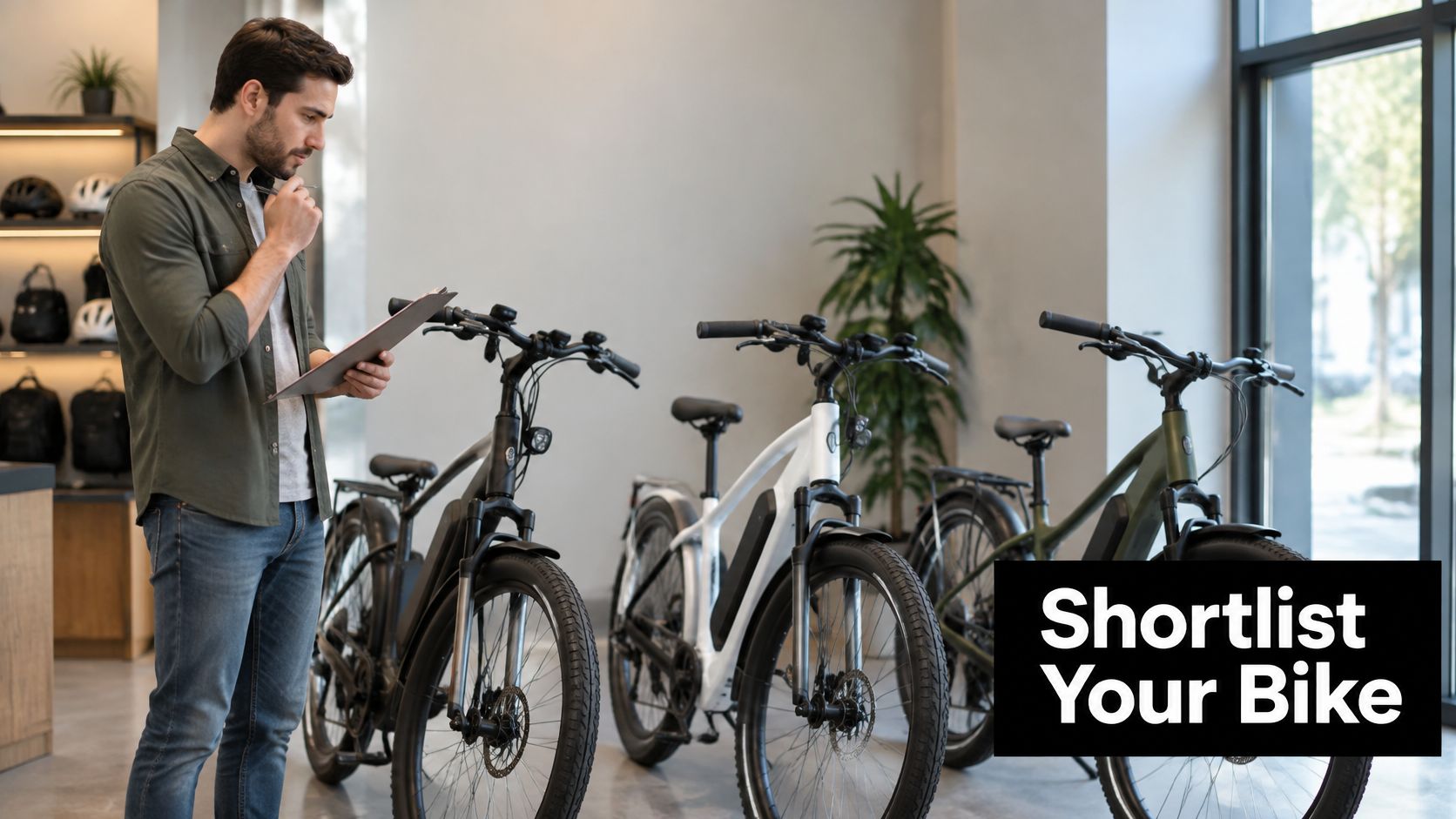
Score three bikes on three points
Give each bike 1 to 3 points under each heading, then add the scores.
- Legal fit: Continuous power is stated, assistance type is clear and your riding areas are confirmed in writing.
- Range margin: The battery covers your longest regular round trip plus 30 per cent at the assistance level you'll use.
- Physical fit: Frame clearance works, reach feels sustainable and you can lift the bike onto a rack or into storage.
One rule overrides the maths. Drop any bike that fails legal fit, whatever its total score. A comfortable, long-range bike you can't ride on your usual paths scores zero in real life, and no discount fixes that.
Worked through plainly, the scoring exposes trade-offs you'd otherwise gloss over. Say a trail model scores 3 for physical fit and 3 for range but only 1 for legal fit because the seller won't confirm output. A commuter scoring 3, 2 and 2 is the better buy for path-based riding. The numbers force you to argue with yourself before money changes hands.
Check servicing before you commit
Ask each seller about the first service interval and who carries it out. E-bikes need motor and battery checks alongside ordinary brake, gear and wheel work, so local workshop support matters after the sale. Rider 18 sells electric bikes, including mountain and commuter types, supplies riders nationwide within New Zealand, and our workshop repairs a wide range of bicycles, from simple basic models to high-end competition bikes and e-bikes. That combination lets you confirm servicing, spare batteries and charger availability before you pay, rather than discovering gaps later.
Ask plain questions and note the answers. Who services the motor system, how long do common parts take to arrive, and what happens if the battery faults under warranty? A seller with clear answers has done this before.
Write a shortlist of three bikes, confirm each one against your checklist, and book a test ride for the top-scoring bike this week. Searching e-bikes for sale in NZ produces endless listings, but a short, scored list turns browsing into a decision you can defend. You'll know why you chose the bike, where you can ride it and what it'll cost to keep running, which is a far better basis for buying than the biggest motor number on the page.
If you're comparing e-bikes for sale in NZ and want the power, battery and fit questions answered before you pay, browse our mountain and commuter e-bikes and talk to our workshop about servicing and setup. Start your shortlist at Rider 18 and book a test ride on the model that passes your checklist.


