

Microshift vs Shimano: The NZ Buyer's Guide
- by Nigel
-

The popular advice is simple: buy Shimano and stop thinking about it. That's lazy advice for New Zealand riders. The smarter question is whether the drivetrain fits your freehub, cable-pull standard, riding style, local parts supply and budget.
Microshift isn't merely a cheaper Shimano copy. Its useful place is clearer than that. Advent X can make sense for an older bike with a Shimano HG freehub, while Microshift's 1x12 options may require a different hub standard. Shimano still earns its premium for riders who demand refined shifting, broad service support and proven performance under hard use.
| Decision point | Microshift | Shimano |
|---|---|---|
| Main strength | Value and straightforward replacement parts | Broad range, refinement and support |
| Useful NZ fit | Advent X on Shimano HG freehubs | Wide compatibility across established Shimano systems |
| Best match | Budget MTB, commuter, older hardtail and practical gravel builds | Aggressive trail riding, premium builds and integrated e-bike systems |
| Main warning | Not every Microshift system shares the same standard | The premium can be wasted if your bike's fitment is wrong |
Why the Microshift vs Shimano Question Matters in New Zealand
Brand reputation should not decide this purchase. In a New Zealand bike shop, start with the wheel already on your bike. A Shimano HG freehub makes Advent X a practical option for refreshing an older drivetrain without replacing the rear wheel. A Microshift 1x12 system may need a different freehub body, and that extra hub or wheel work can erase the initial saving.
NZ riders often keep bikes running for years instead of replacing the complete bike when a cassette, derailleur or shifter wears out. Compatibility and parts availability affect the final bill more than a logo on the lever. Shimano covers a wider spread of drivetrain categories in local catalogues. Microshift has useful but narrower coverage, including road shifters, MTB derailleurs and cassettes. NZ retail listings show both brands in the local supply chain.
Microshift was founded in 1999, while Shimano's bicycle-component origins trace back to 1921, giving Shimano 78 more years in the market. That history and the resulting difference in product depth are outlined in this brand comparison. Shimano's longer history does not make every Shimano component the right choice, but it helps explain the wider shop knowledge, replacement-parts range and service familiarity.
Start with the bike, not the brand
Check the cassette speed, freehub body, derailleur hanger and shifter compatibility before comparing shift feel. Also price the chain, chainring, wheel work and workshop time. A cheaper groupset can cost more once those items enter the job.
Practical rule: If the cassette fits your existing freehub and the cable pull matches the shifter, Microshift deserves serious consideration. If either check fails, stop comparing sticker prices and reassess the complete drivetrain.
For NZ commuters, older hardtails and budget gravel bikes, Microshift can be the sensible choice. Shimano earns its premium for aggressive riding, easier parts sourcing and simpler ownership over the bike's working life. The right decision is the system that matches your existing standards, not the more familiar badge.
Lineups and Groupset Tiers at a Glance
Shimano's range is easier to recognise on a shop floor because it covers almost every price and performance level. On the MTB side, the progression runs from basic Tourney and entry-level families through Altus, Acera, Alivio and Deore, then into SLX, Deore XT and XTR. Deore is the practical centre of the range, while XT adds lighter parts, more polished controls and a stronger premium-riding focus.
Shimano also has a large road and gravel ladder, including Claris, Sora, Tiagra, 105, Ultegra and Dura-Ace. That depth makes it easier to find a replacement at a similar standard, particularly when a rider wants to change one worn component rather than the complete drivetrain.
Microshift takes a more focused approach. Advent and Advent X target practical MTB and mixed-surface riding, while Sword gives road and gravel riders a value-oriented option. Its catalogue includes both 1x and 2x designs, but availability varies by NZ retailer, so a model that looks easy to source online may still need to be ordered through a shop.
| Tier | Microshift | Shimano | Speeds | Approx NZD |
|---|---|---|---|---|
| Practical entry MTB | Advent | Altus, Acera and Alivio | 9 to 10 | Varies by configuration |
| Budget wide-range MTB | Advent X | Deore and CUES alternatives | 10 to 11 | Varies by configuration |
| Trail performance | Advent X Pro | Deore, SLX and XT | 10 to 12 | Varies by configuration |
| Gravel and road value | Sword | Claris, Sora, Tiagra and GRX | 10 to 12 | Varies by configuration |
The key point is positioning. Microshift concentrates on the value space where Shimano's choices can become more expensive or harder to compare. Shimano, by contrast, offers a deeper premium range and more established paths for upgrades.
For a useful NZ overview of the parts categories riders commonly replace, see Rider 18's mountain bike parts guide. Don't choose from the table alone. Confirm the exact cassette, chain and shifter standard before ordering.
Shifting Feel, Weight and Real-World Performance
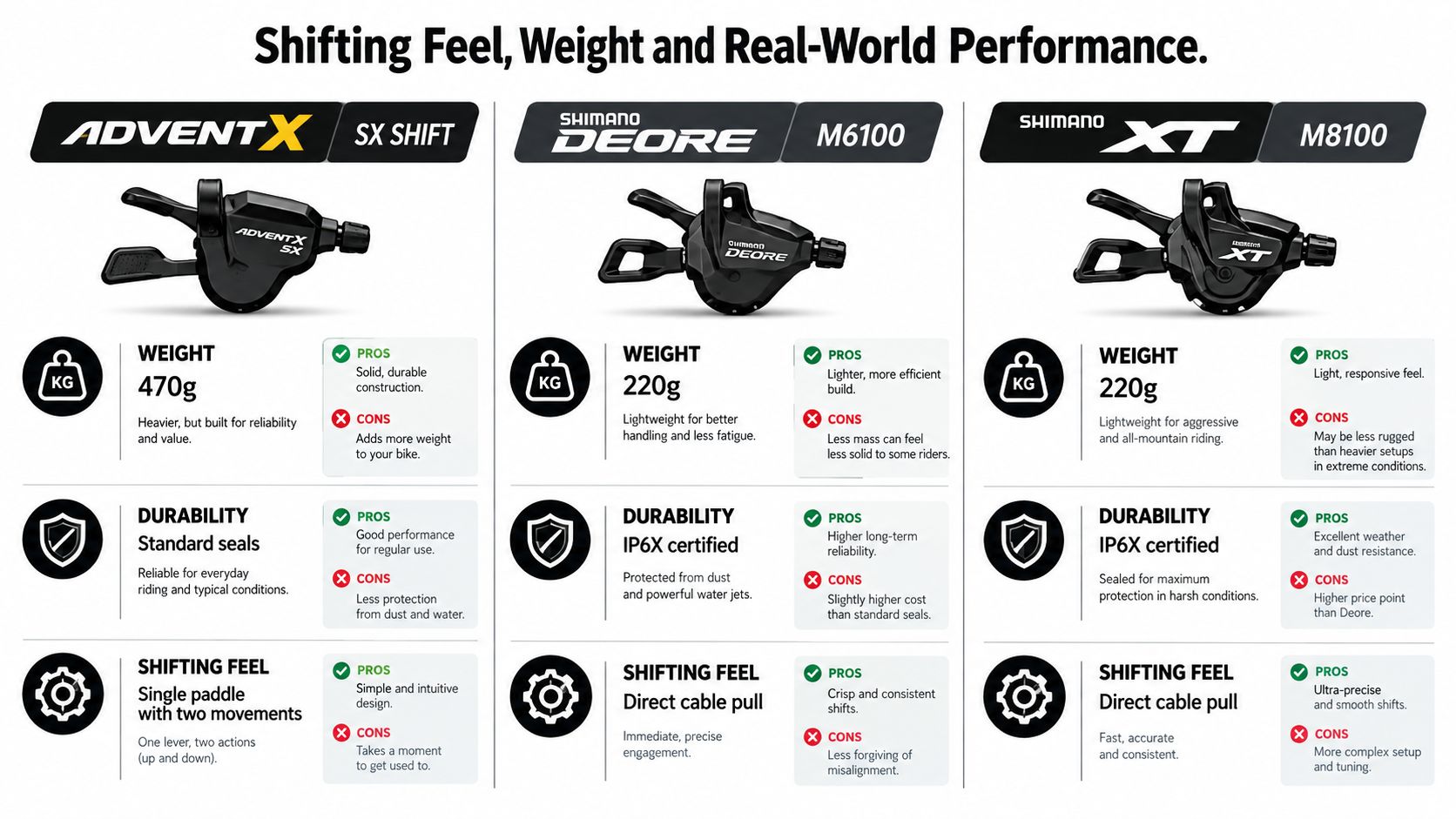
On a stand, Shimano usually feels more polished. The lever action is smoother, the shifts are quieter and higher-tier controls offer useful features such as multi-release shifting. Advent X has a more mechanical feel, with a firmer click and a less refined lever action, but it still gives a clear shift and a clutch-equipped derailleur can keep the chain under control on rough ground.
The published Advent X and Shimano XT comparison gives the clearest hard data. Advent X uses an 11-48T cassette, an average gear jump of 17.8% and a listed weight of 424g. Shimano XT is shown with 10-51T, a 16.0% average gear jump and a listed weight of 470g. Those specifications come from Microshift's Advent X product information.
What the numbers mean on the trail
The XT cassette offers a slightly tighter progression and a larger climbing sprocket. That gives a rider more closely spaced cadence changes and a little more low-range capacity. Advent X counters with the lower listed cassette weight in this comparison and a simpler 1x approach, which suits riders who want fewer parts and don't need the broadest climbing range.
You'll notice the difference most when shifting under pressure. XT generally moves between gears faster and with less noise, especially when a rider is climbing hard and changing gear late. Advent X can sound more pronounced and the lever may need a firmer push, but that doesn't make it a poor trail drivetrain.
Shop-floor verdict: For an everyday rider, the difference is mostly feel and refinement. For aggressive riders who shift while sprinting, climbing or landing through rough terrain, Shimano's better control and clutch behaviour are worth paying for.
Durability depends on setup as much as the brand. A bent hanger, dirty cable, worn chain or poorly adjusted limit screw can make an expensive drivetrain shift badly. Microshift's adjustable clutch helps it compete in practical trail use, while Shimano's higher-tier clutch systems remain the safer choice for riders who regularly ride hard, hit rough descents and expect quiet chain control.
Commuters, tourers and recreational gravel riders shouldn't overpay for performance they won't use. If the bike is correctly adjusted and maintained, Advent X can deliver dependable shifting without the cost of a premium Shimano group.
Compatibility, Cable Pull and Freehub Standards
Many otherwise useful comparisons go wrong here. “Shimano-compatible” can refer to the cable pull, cassette body, chain or a broader parts ecosystem. Those are separate checks, and one matching standard doesn't guarantee that the whole drivetrain will work together.
Start with the cassette. Microshift Advent X uses a Shimano HG 8 to 11-speed freehub body, so it can suit many older mountain bikes and hardtails. Microshift's 1x12 systems are not automatically the same fit. Some require a Microspline-compatible body, so check the exact product rather than assuming every Microshift cassette will fit an existing wheel.
| Groupset | Speeds | Freehub body | Cable pull | Chain |
|---|---|---|---|---|
| Microshift Advent | 9 to 10 | Shimano HG | Match the specified Microshift system | Matching 9 or 10-speed chain |
| Microshift Advent X | 10 | Shimano HG | Microshift Advent X standard | Matching 10-speed chain |
| Shimano Deore | 11 | Shimano HG or model-specific fit | Shimano standard for the group | Matching 11-speed chain |
| Shimano 12-speed MTB | 12 | Often Microspline | Shimano 12-speed standard | Matching 12-speed chain |
| Microshift Sword | Model dependent | Check exact cassette specification | Sword-specific system | Matching Sword chain specification |
Cable pull is the second checkpoint. A shifter pulls a measured amount of cable, and the derailleur converts that movement into lateral travel. A Microshift shifter and derailleur need to share their intended actuation standard. You can't assume that a Shimano shifter will index a Microshift derailleur just because both are mechanical.
Check the controls and chainline
Look at the shifter mount as well. Shimano I-Spec systems attach to compatible Shimano brake levers, while a clamp-mounted Microshift shifter may need its own space on the handlebar. Brake lever integration, clamp diameter, derailleur mounting and chainline can all create problems that a cassette comparison won't reveal.
For a practical product-level look at the system, use Rider 18's Microshift Advent X guide. Take a photograph of the cassette, freehub and shifter before visiting a shop. That gives the mechanic something concrete to identify.
Before you order: Count the cassette speeds, identify HG or Microspline, confirm the cable-pull family and check the chainline. If any answer is uncertain, don't place the order yet.
Price, Value and Long-Term Cost
Microshift's value comes from the cost of a complete, working drivetrain, not one unusually cheap component. NZ listings put Microshift Sword road shifters at $179.99 for Sword 1x10 and $283.99 for Sword 2x10, as noted earlier. Those figures make Microshift attractive for a commuter repair, an older hardtail refresh or a practical gravel build.
Independent comparisons commonly place Microshift below Shimano on price, with one buyer guide describing it as typically 30 to 50% cheaper than equivalent Shimano groupsets. The comparison also discusses Shimano-compatible cable-pull ratios and HG freehub use. The saving only holds if the chosen cassette, freehub body and controls already suit the bike.
Look beyond the checkout total
Price the whole job, including the chain, chainring condition, cables and housing, workshop labour, cassette tools and any wheel changes. A cassette that does not fit your existing freehub can turn a low-cost drivetrain swap into a wheel upgrade. Check the hub standard before buying parts, especially because Microshift Advent X uses a Shimano HG body, while Microshift 1x12 systems do not use that same assumption.
| Groupset | Speed | Shifter + derailleur | Cassette | Chain | Total bundle |
|---|---|---|---|---|---|
| Microshift Advent | 9 to 10 | Lower-cost value option | HG-compatible options | Matching speed | Varies by build |
| Microshift Advent X | 10 | Budget wide-range option | 11-48T published specification | Matching 10-speed | Varies by build |
| Shimano CUES | 10 to 11 | Durable, practical option | HG-compatible options | LinkGlide-compatible choice | Varies by build |
| Shimano Deore | 11 to 12 | Broad trail range | HG or Microspline by model | Matching speed | Varies by build |
| Shimano SLX or XT | 12 | Premium trail controls | Microspline commonly used at 12-speed | Matching 12-speed | Varies by build |
Shimano's premium shows up after installation. Its wider NZ parts network makes replacement cables, shifters, cassettes and derailleurs easier to identify and source. NZ catalogues cover Shimano across more cassette and shifter standards, while Microshift sits in narrower categories. The NZ MTB shifter listings show that difference in category depth.
Choose Microshift when it fits the wheel you already own and your riding does not demand premium shifting. Choose Shimano when service access, precise control and familiar long-term parts support justify the extra cost. Keep the drivetrain clean and correctly adjusted, and follow Rider 18's scheduled maintenance guide for a clear service routine.
Best Use Cases for MTB, Gravel, Commuting and E-Bikes
The right answer changes with the bike. A drivetrain that's perfectly sensible on a commuter can feel under-equipped on a steep, technical trail, while a premium trail group can be unnecessary weight and expense on a town bike.
Mountain bikes
For a budget hardtail, Microshift Advent X is the strongest case. Its wide-range cassette, clutch derailleur and Shimano HG fit make it useful for refreshing a bike without immediately replacing the rear wheel. It suits riders who want a simple 1x setup and accept larger jumps between gears.
Shimano Deore is the better all-round trail recommendation. It offers a more familiar upgrade path, broader parts support and a refined shift under load. XT is justified for riders who care about lower system weight, sharper control and high-quality controls, not for someone riding rail trails at a relaxed pace.
Gravel bikes
Microshift Sword makes sense for value-focused gravel builds where the rider wants practical mechanical shifting and a lower entry cost. Advent X also works for a simple 1x gravel setup, particularly when the bike uses an HG freehub and the rider values climbing range over close ratios.
Shimano GRX remains the more convincing choice for riders who spend long days on mixed surfaces and want gravel-specific ergonomics and braking integration. Choose Shimano when you want a familiar service path. Choose Microshift when the bike's fitment is straightforward and your budget matters more than the last layer of lever refinement.
Commuters and e-bikes
For commuters, Advent or Advent X is easy to justify. Replacement parts are practical, the controls are uncomplicated and a compatible HG wheel can stay in service. Shimano CUES is worth considering for riders who prioritise durability and a structured Shimano parts ecosystem.
E-bike buyers need more care. Microshift's sturdy mechanical components can suit a bike where the rider accepts conventional shifting, but Shimano has the stronger case when the drivetrain must integrate with a Shimano drive unit and its electronic or system-specific controls. Check the motor, display, shifter and derailleur requirements before buying anything.
My recommendation: Microshift for budget repairs and straightforward mechanical bikes. Shimano for aggressive MTB, integrated e-bikes and riders who want the easiest long-term service path.
Fitment Checklist for Your Bike
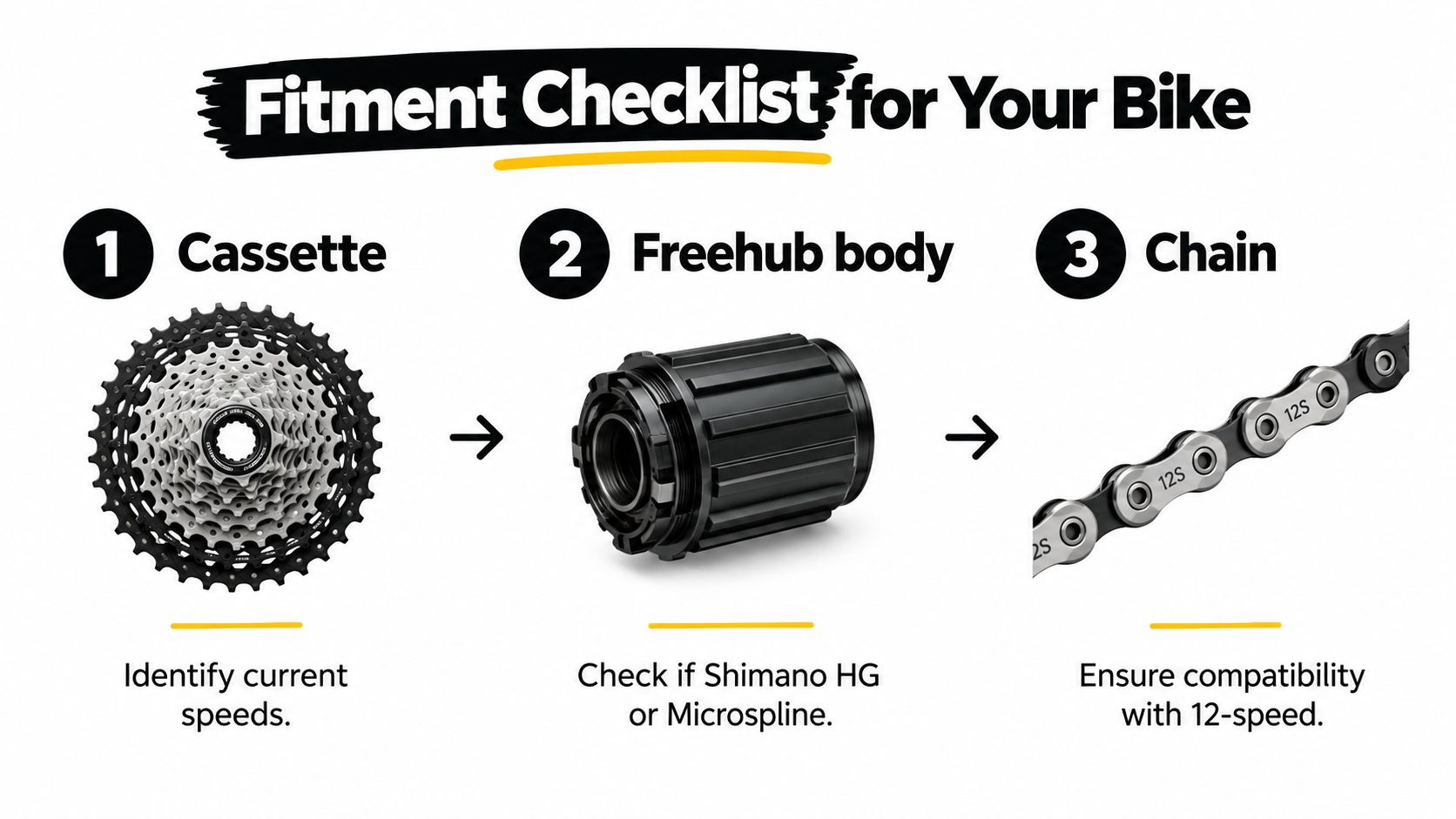
Don't order a drivetrain from a product photograph alone. Use this sequence and write the answers down before you compare prices.
- Identify the current cassette. Count the sprockets, photograph the largest sprocket and check the cassette body. The common choices you're separating are Shimano HG and Microspline.
- Match the drivetrain family. A Microshift Advent X setup is designed around its own shifter and derailleur pairing, with the cassette using the Shimano HG format described earlier. A 12-speed system may use Microspline, so the speed count alone isn't enough.
- Check the physical fit. Confirm derailleur mounting, chainline, shifter clamp, brake-lever integration and chain width. A mechanic should also inspect hanger alignment, cable housing and the condition of the chainring before installing new parts.
The workshop checks people skip
A worn chain can damage a new cassette. A bent hanger can make either brand shift poorly. The correct cassette tool and lockring interface also matter, especially when a rider is moving between standards.
Take the bike, not just the old parts, to a local shop if you're unsure. Ask them to confirm the freehub, chainline and cable-pull match before ordering. That short inspection is cheaper than discovering that your new cassette needs a different wheel body or your new shifter doesn't index the derailleur.
Rider 18 Recommendations and Maintenance Notes
For a budget trail hardtail, I'd choose Microshift Advent X when the existing wheel uses the right HG freehub and the rider wants a straightforward 1x drivetrain. For an older commuter or tourer, Microshift Advent can be a sensible refresh if the shop confirms the shifter, derailleur, cassette and chain belong to the same system.
I'd choose Shimano Deore or XT for a Microspline-based 12-speed build, aggressive trail riding and Shimano-integrated e-bikes. The premium buys a more polished shift, a deeper support network and an easier path to matching replacement parts. Gravel riders should choose Sword for value-focused mechanical builds and GRX when lever ergonomics, braking integration and Shimano familiarity matter more.
Wash the drivetrain regularly, lubricate the chain for the conditions and replace worn parts before they damage new ones. Ask a mechanic to check hanger alignment whenever shifting remains poor after adjustment, and don't fit a new cassette without checking chain wear.
If you're budgeting for repairs across several vehicles or bikes, a separate question is whether Nomu is right for your used vehicle. It's not a drivetrain decision, but it's the kind of wider ownership cost worth checking before committing to ongoing repair expenses.
If you're unsure whether your bike needs Microshift or Shimano, take the cassette and freehub details to Rider 18 for a practical compatibility check. The Nelson team can help match the drivetrain, parts and workshop work to your bike, riding and budget, with nationwide shipping available for compatible components.


