

E Bike Laws NZ: Power Limits, Rules and Where You Can Ride
- by Nigel
-

A standard e-bike in New Zealand is a power-assisted pedal cycle when its combined maximum motor output is 300 watts or less; above that figure, it falls outside the standard category and may face different legal requirements. But if your bike qualifies as a bicycle, does that mean you can ride it at full assistance wherever bicycles are allowed?
That's the gap many summaries of e-bike laws in NZ leave open. Classification tells you which rules apply to your machine. It doesn't settle whether your speed, route or passing manoeuvre is appropriate around pedestrians, children or other riders.
For commuters, parents and recreational riders, the practical task is to check the machine first, understand where it belongs, then make riding choices that go beyond minimum compliance.
Which E-Bikes Count as Legal Bicycles in New Zealand
Under NZTA's vehicle-classification framework, class AB covers a pedal cycle fitted with auxiliary propulsion motors whose combined maximum output doesn't exceed 300 watts. The word combined matters: fitting multiple motors doesn't give each motor a separate allowance.
A qualifying power-assisted pedal cycle is treated as a cycle. Ordinary cycling rules apply, rather than the licensing, registration and warrant requirements associated with motor vehicles.
That cycle status is a floor, not a ceiling. Meeting the 300-watt limit tells you the bike is legal; it says nothing about how fast you should pass a dog walker on a shared path. And once output climbs past that threshold, the machine leaves the bicycle category entirely, however much it still looks like one.
The classification starts with what the machine is and how it's powered, not its name in an online listing. A seller calling something an e-bike, commuter or trail bike doesn't establish its legal status.
Device classes by motor output and legal treatment
| Device | Motor output | How it is treated | What to check |
|---|---|---|---|
| Power-assisted pedal cycle | 300 W or less, combined | Treated as a cycle, so ordinary cycle rules apply | Helmet, lights, brakes and road positioning |
| Pedal-assisted bike above the cycle limit | Above 300 W | Outside the standard power-assisted category, in a different legal class | Confirm the legal class before buying or modifying |
Mopeds, electric dirt bikes, wheeled recreational devices and mobility devices each sit in their own class under the national framework, with criteria you confirm against the specific model. None of them is an alternative label you can choose for a powerful bicycle. A mobility device and a bicycle serve different purposes, even though both may use batteries and electric motors.
Check the specification, not the advertising headline
Look for the manufacturer's specification for the exact model and configuration you're buying. Battery capacity, range claims and an impressive climbing description don't establish motor-output compliance.
If the documents distinguish nominal, continuous and peak output, don't select whichever figure looks convenient. Ask for written clarification of the legally relevant maximum output and the basis for its New Zealand classification.
Before paying, apply this test:
- Pedal-cycle design: Is it a pedal-driven cycle with auxiliary electric propulsion?
- Combined output: Does the documented motor configuration fit within the 300-watt cycle allowance?
- Written evidence: Can you keep the manufacturer's specification with your purchase records?
Buying rule: If the seller can't explain the bike's classification with documents, resolve that uncertainty before taking it onto public routes.
Electric Dirt Bikes and Devices Above 300 Watts
A buyer finds a used electric dirt bike advertised as suitable for getting around town. It's quiet, looks manageable and costs less than another commuter they've considered. None of those details confirms that it can legally be used as a bicycle.
The financial consequences can be substantial: New Zealand Police's warning about electric dirt bikes reported in 2025 that officers were dealing with roughly four cases per week, and that retrieving one impounded e-bike after a 28-day impound period cost $900. That was a reported retrieval cost for a particular impounded bike, not a universal fine for every classification issue.
Follow the machine's paperwork
For the hypothetical buyer, the next step isn't buying a cycle helmet and assuming the problem is solved. It's establishing the machine's legal class and whether its documents support the intended use.
An electric dirt bike doesn't become a legal pedal cycle because its owner rides slowly. Nor does adding bicycle-style accessories establish that it meets another vehicle class's requirements.
Ask for:
- Original specifications: Match the manufacturer's documents to the exact model.
- Modification history: Identify replacement motors, controller changes and altered settings.
- Road-use evidence: If the seller claims it's road legal, ask for documentation supporting that claim and its registration status.
A second-hand listing saying “previous owner used it for commuting” isn't evidence of compliance. Neither is a photograph of someone riding it on a public path.
Modifications can change the answer
A larger motor or a controller change that increases available output can alter the basis on which a bicycle qualified. Before approving that work, establish what the change does to the machine's output and classification.
Not every component replacement changes legal status. Replacing worn brake pads is different from altering the propulsion system, but an undocumented replacement controller deserves scrutiny.
A legal commuter and an unregistered off-road machine may look similar in an advertisement. Buy on documented classification, not appearance.
If you can't establish the class, don't use a public ride as a test of whether anyone objects. Resolve the paperwork and intended riding location first.
Speed, Power and Motor Assist Limits
At the time of NZTA's low-powered-vehicle report, New Zealand had no general maximum motor-assisted travel speed for low-powered vehicles; for bicycle-style e-bikes, the principal dividing line remained 300 watts of combined maximum motor output.
That finding needs its historical context. It isn't a promise that rules will never change, and it doesn't mean riders have no speed-related responsibilities. The report discussed possible future maximum assisted speeds and size limits for devices using footpaths, rather than establishing those proposals as current permissions.
Motor output isn't travelling speed
Power describes the motor's output. Travelling speed describes how quickly you're moving, which also changes with pedalling, gradient and riding conditions.
A low assistance setting doesn't prove that a higher-powered machine qualifies as a cycle. Equally, a compliant bicycle can still be ridden too quickly for the space available.
When comparing e-bikes for sale in NZ, examine the assistance controls as carefully as the range description. You should understand how assistance starts, how it changes between modes and when it stops.
Before riding an unfamiliar bike:
- Read the operating instructions: Check any stated assisted-speed behaviour and cut-out conditions.
- Practise away from congestion: Learn how promptly the motor responds when you start pedalling.
- Choose assistance deliberately: Don't leave the bike in its strongest mode because that was useful on the previous hill.
Treat overseas e-bike labels cautiously, too. A category used in another country doesn't establish New Zealand compliance.
Legal classification is the starting point, not a target riding speed. Choose a pace that lets you respond to what's ahead, rather than what the motor can deliver.
Roads, Cycle Lanes and Shared Paths Explained
On the road, a qualifying e-bike follows ordinary cycle rules, including keeping as close as reasonably possible to the roadway edge. “Reasonably possible” calls for attention to the usable road surface and hazards, not blindly following the gutter.
A designated cycle lane gives riders an identifiable space, but it doesn't remove the need to watch driveways, intersections and other road users.
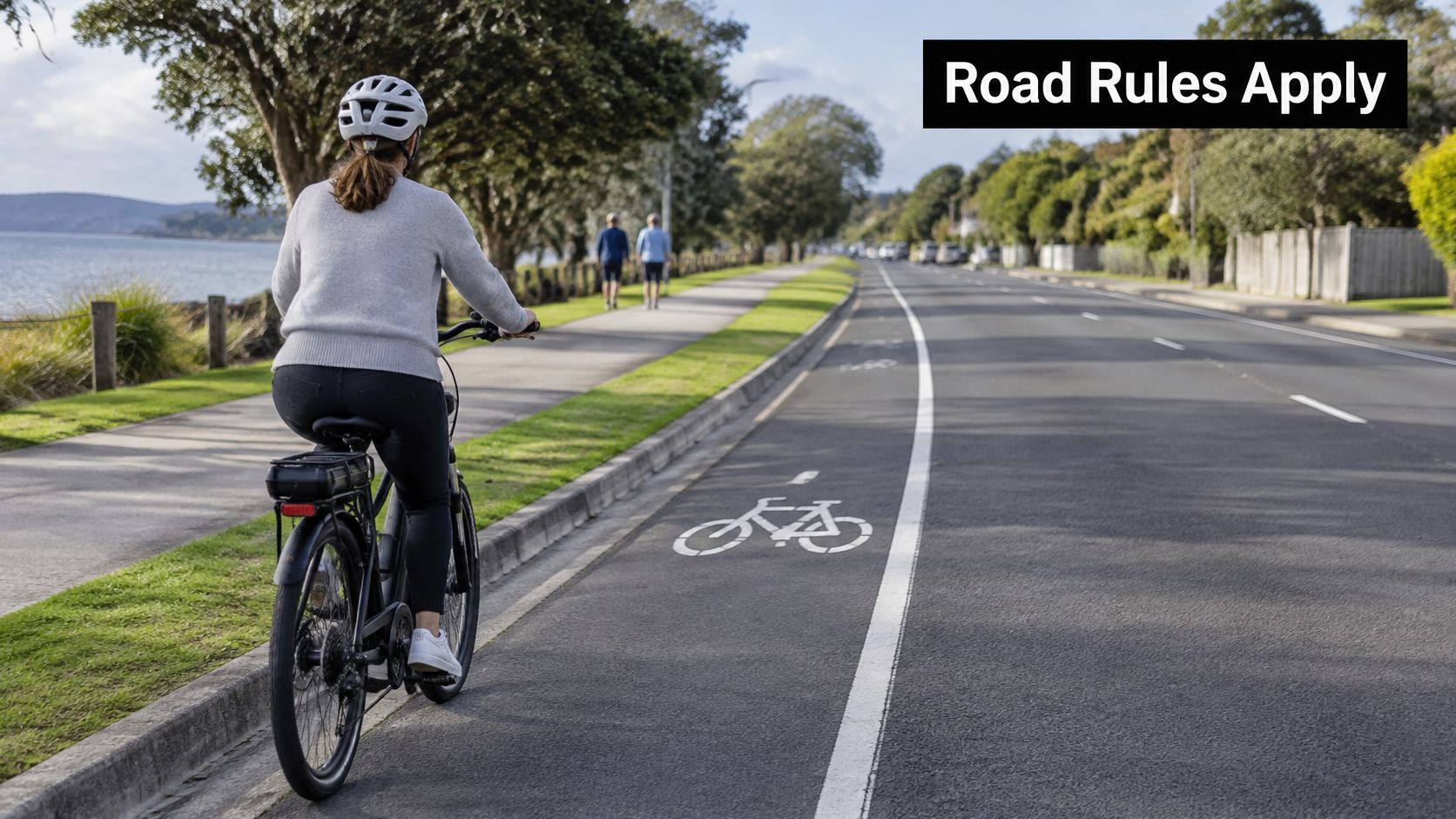
The NZTA Cycling Code sets out equipment and signalling duties, including signalling for three seconds where safe, while its e-bike guidance advises choosing low power on shared paths and a speed consistent with other users. That distinction matters: permission to enter a path isn't permission to make others feel unsafe when you pass.
Shared access requires shared consideration
Check signs and route information before assuming a path permits cycling. A shared path, a footpath and a mountain-bike trail aren't interchangeable because each is separated from traffic.
Where cycling is permitted, adjust before you reach a conflict:
- Blind corners: Slow while you can still see clear space ahead, rather than braking after someone appears.
- People and dogs: Leave room for an unexpected sideways movement or a lead across your line.
- Children: Allow for sudden stops and changes of direction.
- Narrow sections: Wait if you can't pass without crowding someone.
There isn't a useful universal passing gap for every path layout. If the available width would force someone towards an edge, stop or wait instead of squeezing through.
Courtesy test: If another user has to jump aside, shorten a dog's lead suddenly or pull a child out of your way, your approach needed more margin.
For a riding demonstration alongside this guidance, watch the video below.
Choose the route for the conditions
A Nelson commuter may find a shared route comfortable early in the morning but unsuitable when families fill a narrow section later. A parent accompanying a child may need enough room to stop together, while an older rider may prefer a route without awkward uphill starts.
Heavier e-bikes deserve care when starting at intersections or on hills. Select manageable assistance before stopping, and leave room to get moving without drifting into someone else's line.
Stop at red lights and for pedestrians at crossings as required. For recreational trips, use mountain-bike path information to investigate route suitability, then confirm access signs and conditions locally.
Sometimes the courteous choice is another route, another departure time or walking the bike through a crowded section.
Gear, Pre-Ride Checks and Legal Confirmation
A compliant specification doesn't make a poorly maintained bicycle ready to ride. Equally, excellent brakes and bright lights don't resolve an uncertain vehicle class.
Work through the checks below before your first outing, then repeat the condition checks before each ride. Keep the manufacturer's documents somewhere accessible so you don't have to reconstruct the bike's history when it needs repairs.
Get yourself and the bike ready
-
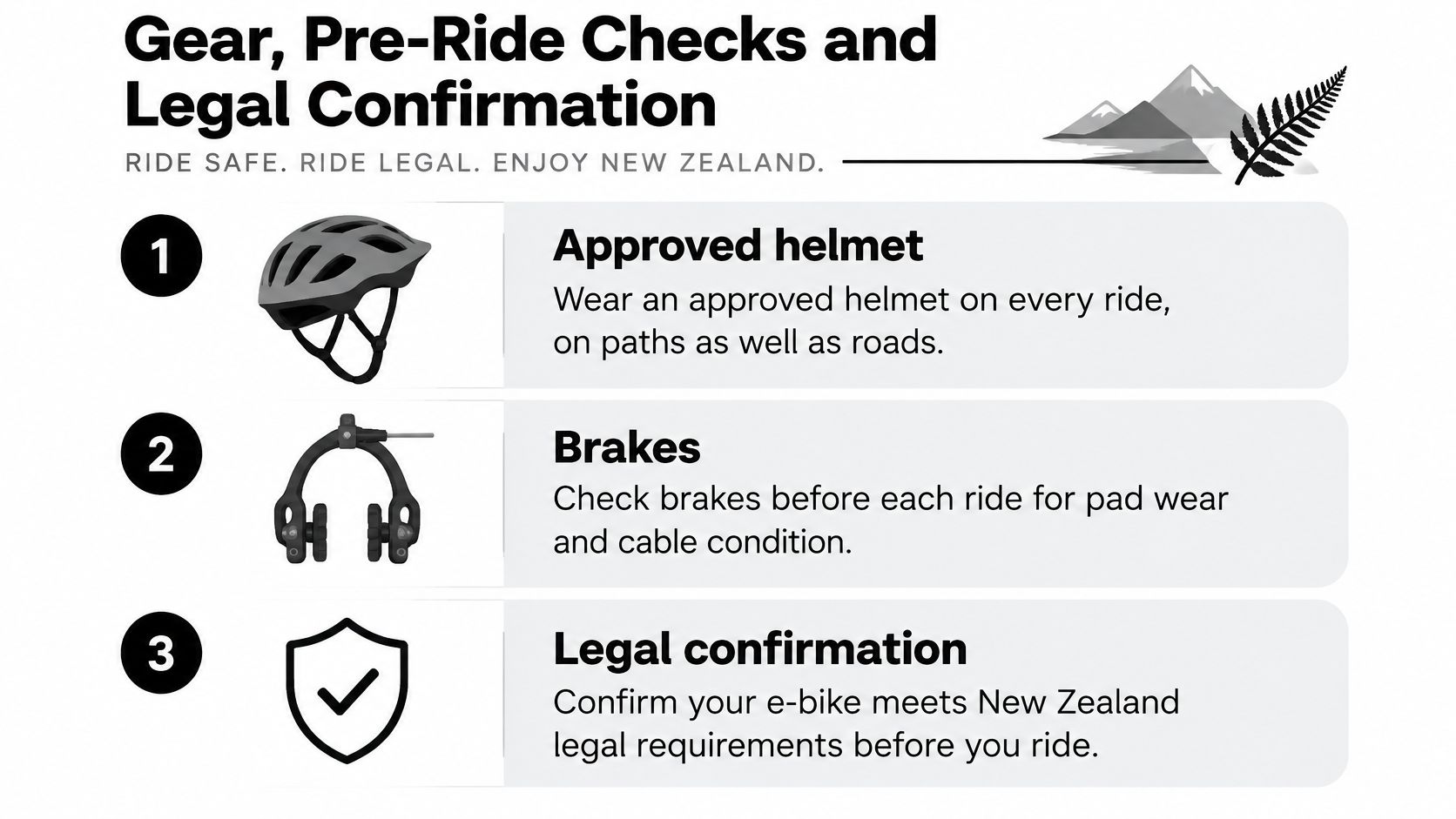
Fit an approved cycle helmet. Wear it on paths as well as roads because a separated route doesn't remove the risk of a fall.
Position the helmet level, adjust the retention system and fasten the straps so it stays secure without being uncomfortable. Inspect the shell, liner and buckle, and follow the manufacturer's replacement guidance after an impact. Our bicycle helmet guide can help you consider fit alongside protection.
-
Test the brakes before setting off. You need predictable stopping, not just levers that move.
Check pad wear and cable condition where cables are fitted. With hydraulic brakes, look for leaks and an unusual change in lever feel. Push the bike forward and apply each brake separately; if a lever pulls unusually far or the bike doesn't stop firmly, investigate before riding.
-
Check lights and reflectors. Suitable lighting and reflectors help others identify you when visibility drops.
Inspect the front and rear lights, charge or replace their batteries as needed, and clean muddy lenses. Make sure bags, jackets and luggage don't obscure them. A light that switches on but is barely visible shouldn't pass your practical check.
-
Practise clear hand signals. Other road users need time to understand your intended movement.
Check that you can look behind and signal without swerving. Use the appropriate signals for turns and stopping, but retain control when the surface or traffic makes releasing the handlebar unsafe.
Use this visual checklist as a reminder before your first ride.
Confirm the machine and the journey
-
Keep the output specification available. Written evidence lets you check the actual configuration rather than relying on memory or a seller's description.
Match the documents to the bike's model and installed motor system. If the label is missing or the specification is ambiguous, resolve it before assuming the bicycle classification applies. Battery size alone won't answer that question.
-
Check pedal operation and modification history. The bike you're riding needs to match the machine described in its paperwork.
Inspect replacement parts and ask what any controller or motor work changed. Don't assume a software setting restores compliance without reliable confirmation. If it's second-hand, keep receipts and any service records with the original specification.
-
Plan a route that you can ride considerately. Your destination matters, but so do the people and obstacles between you and it.
Identify busy shared sections, awkward junctions and places where you may need to dismount. Choose a manageable assist setting before entering those areas, rather than trying to change modes while passing someone.
For workshop support, our E-Health Check costs $59.00 and includes plugging the bike into diagnostics, applying updates where required, checking the error log and components for wear, and a function check and test ride. A mechanical or diagnostic check isn't a substitute for establishing the correct legal classification.
Finish with the same short routine every time: helmet fitted, brakes tested, lights ready, output documentation confirmed and assistance set appropriately for the route. Fix uncertainty before departure, not at the first busy crossing.
We sell electric mountain and commuter bikes, with workshop support to help you keep your bike functioning properly. Visit Rider 18 with your riding plans and bike specifications to discuss a suitable bike or arrange servicing before your next commute or family ride.


Please upload banner from store admin blog pages