

Tow Ball Mounted Bike Rack Fit and Load Guide
- by Nigel
-

You've got a 50 mm tow ball on the back of the car, two bikes to shift and a boot already full of helmets, a chilly bin and a wet towel. The listings in front of you run from a folding two-bike hanger to a platform built for e-bikes, and every photo looks capable. What the photos leave out is the part that decides the purchase: whether the rack holds your heaviest bike, whether it clamps your ball without play, and whether the rear plate and tail lamps stay legal once the bikes are on.
That last question catches more buyers than any other. In New Zealand, a loaded rack turns the car into a vehicle carrying a load, and the load has to stay restrained with its lights and plate visible. So the buying order isn't brand, then price, then fit. It's style and kilograms, then ball and car fit, then e-bike mass, then lights and plates, then a shortlist you can price properly.
Why the Tow Ball Becomes the Carrier
The trailhead car park on a Sunday morning. Two muddy mountain bikes, a third with a battery locked into the downtube, and a boot already holding a dog, a helmet bag and the post-ride snacks. Nothing else fits. The 50 mm tow ball is the only mount left, so a tow ball mounted bike rack goes on the back.
A tow ball mounted bike rack clamps or locks onto that ball rather than gripping roof rails or sliding into a square hitch receiver. Bikes ride at bumper height, which is the whole appeal: you lift a 24 kg machine to waist level instead of pressing it over your head, and no frame ever scrapes the garage door frame on the way out. The trade sits exactly where the rear number plate and tail lamps are, because that's the space the bikes now occupy.
NZTA treats those bikes as a load, not as an accessory. Bicycles on a rack can hide the plate or the essential tail lights, so the driver must fit additional lights and a supplementary plate when the view from behind is obstructed, and the load has to stay restrained for the entire journey.
On average, 7 people are killed and 45 seriously injured each year in crashes involving a light vehicle towing a trailer, and incorrect loading contributes to about 27 light-vehicle crashes annually, including roughly 1 death and 5 serious injuries, according to NZTA's safe loading and towing guidance.
Those figures describe towing and trailer use, not bike racks. They still make the point that restraint and visibility are decisions, not afterthoughts.
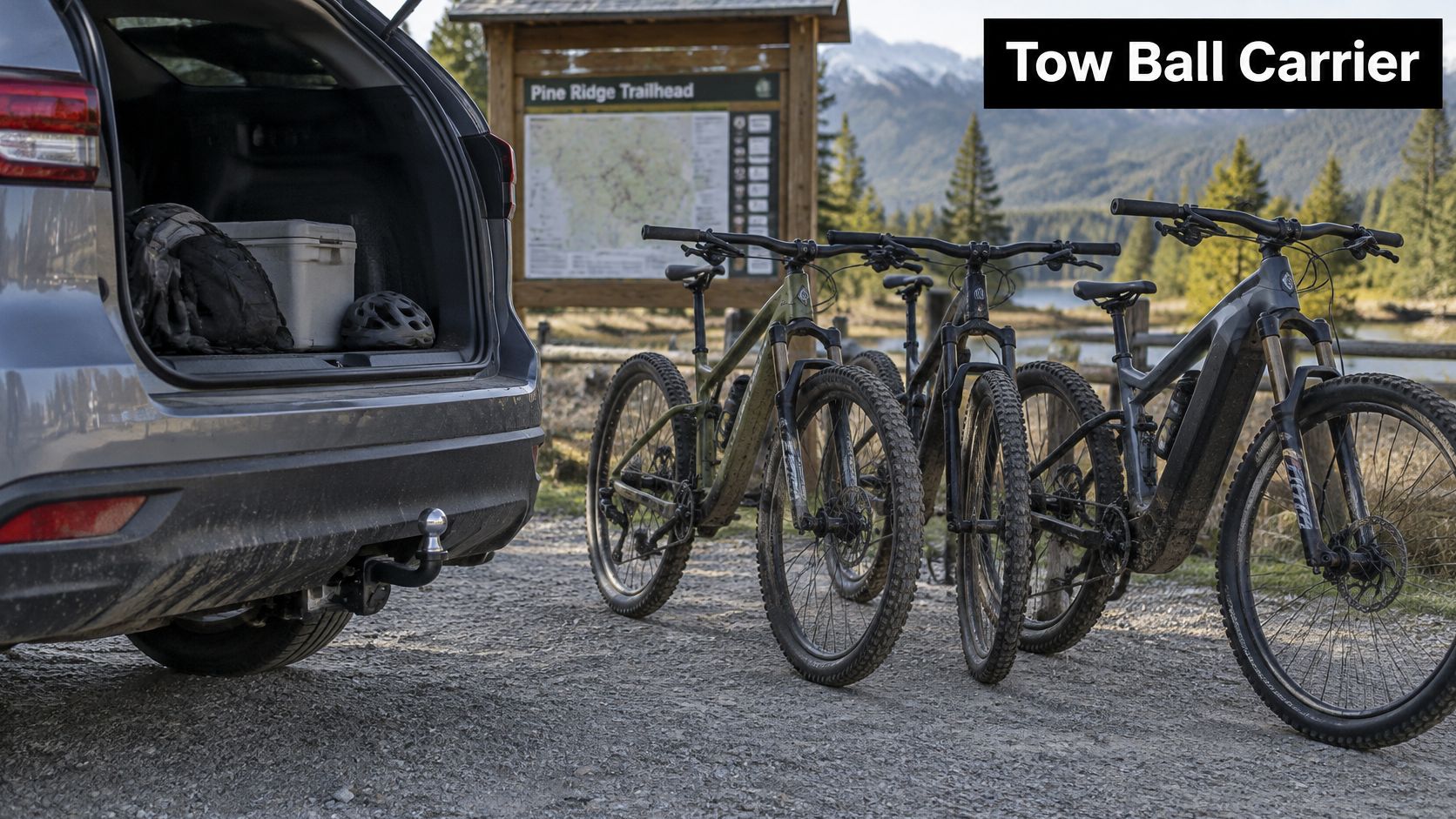
The order that follows is deliberate. Style and kilograms come first, because they eliminate racks before you fall for one. Then comes ball and car fit, then e-bike mass, then lights and plates, and only then a shortlist worth pricing.
Rack Styles and What Each One Carries
Pick a row before you read the argument. The columns hide less than a showroom does.
| Style and example | Bikes | Stated weight limit | Best match | 2026 NZ price |
|---|---|---|---|---|
| Hanging towbar rack, Thule HangOn | Up to 4 | 15 kg maximum per bike | Light road and cross-country bikes | Not listed in the pages checked |
| Folding hanging rack, EziGrip Advantage 2 | 2 | Not stated, confirm on the product plate | Occasional trips with light bikes | NZ$149.00 |
| E-bike platform, EziGrip E-Volve 2 | 2 | Rated for two e-bikes | Heavy e-MTBs with batteries on | NZ$1,385.00 |
| Platform towbar rack, Yakima JustClick 2 | 2 | Not stated, ask before ordering | Riders wanting a fast wheel-on load | From NZ$1,399.00 |
Hangers Hold Frames, Platforms Hold Wheels
Two families sit behind those rows, and the hanging family has a clear capacity benchmark. Thule New Zealand's towbar rack range states that its HangOn rack carries up to four bikes with a maximum bike weight of 15 kg each. That's a generous bike count and a modest per-bike allowance, and the gap between those two numbers is where most mismatches begin.
A hanger works like a coat hook. It's fast, light and often folds flat, and it holds a coat beautifully right up until the coat has no shoulders or weighs more than the hook allows. Bikes hang from the top tube or from padded arms, so the frame becomes part of the load path.
A platform rack is the shelf instead. Each wheel drops into a tray, straps pin the wheels or the frame, and the weight travels through the wheels and tyres rather than through a thin carbon tube. That's why platforms dominate the long-travel, odd-frame and e-bike end of the market, and why they cost what they cost.
Where a Bargain Rack Runs Out of Road
The price spread is real and it isn't marketing. 99 Bikes New Zealand listed the EziGrip Advantage 2 at NZ$149.00 in 2026, and Cycle Science listed the Yakima JustClick 2 from NZ$1,399.00. The extra money buys tray hardware, a higher load rating and, on a properly specified platform, the light board the wider bikes will demand.
The failure modes follow the rows. A hook can crush a carbon top tube or swing a pedal into the next bike's fork. A per-bike ceiling rejects most e-mountain bikes the moment the battery is fitted. A two-bike folder is a sensible answer for occasional light bikes and a poor answer for a weekly shuttle of two heavy machines.
Practical rule: if a listing doesn't state a per-bike kilogram limit, treat the limit as unknown until you've read the product plate on the rack itself.
Then circle the row whose bike count and per-bike limit cover the heaviest bike you own, not the average one. If you're still narrowing it down, these towbar rack buying notes for New Zealand riders walk through the same trade-offs from the driver's side.
How the Rack Meets the Tow Ball and Car
Fitment is four checks, in order. Stop at the first one that fails, because each check assumes the one before it passed.
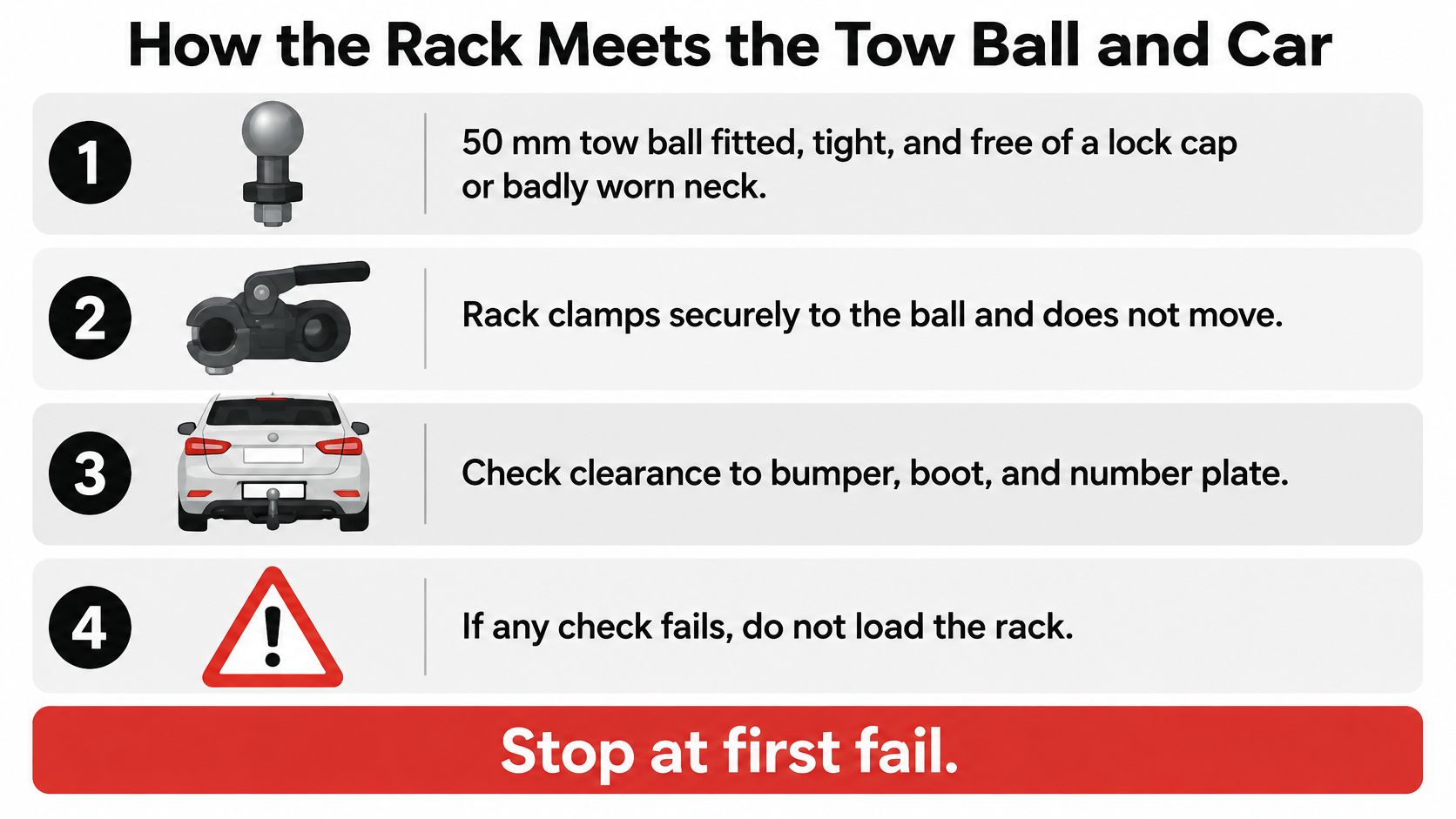
- Confirm the ball itself. A 50 mm ball, torqued tight, with a clean and grease-free neck. Grease is what stops a clamp biting, and a worn neck or a lock cap left in place does the same job from the other direction.
- Match the clamp to the neck. Read the rack's minimum and maximum ball-neck size and compare it with what's on your car. A clamp that bottoms out on a thick neck, or spins on a thin one, is the wrong rack rather than a badly adjusted one.
- Open the boot through its full arc with the rack empty. Look for bumper contact, sensor blockers and spare-wheel clashes. If the tailgate needs to open on the road, a tilting or swing-away rack solves it and a fixed one doesn't.
- Find the electrical socket. A light board needs a trailer plug, often 7-pin on older cars and 13-pin on newer ones. No socket means a wiring job before the first trip, not after.
If you'd rather see the clamp engage before you read more, this walkthrough runs the sequence at the ball.
The Load the Ball Is Already Carrying
Here's the number most buyers never check. The rack's own mass plus every bike on it counts toward the towball download the vehicle maker publishes, and that figure is usually far below the braked towing capacity people quote at the barbecue. A platform built for two e-bikes can consume much of a small car's allowable download before a single bag goes in the boot.
There are smaller fitment traps too. An empty rack may sit across the rear number-plate lamp, or park itself in front of a reversing sensor and a rear camera, so the car starts beeping at nothing and showing a grey wall on the dash screen. Check those with the rack fitted and empty, then again with bikes loaded.
Pass rule: the clamp bites the ball with no play, the tailgate still opens or the rack tilts clear, and a plug exists for whatever lighting the load ends up needing.
If you're comparing clamps, how EziGrip's tow ball racks are set up shows what a properly seated clamp looks like before the bikes go on.
Bike Weight E-Bikes and Frame Shape
Start with the bike, not the brochure photo. Weigh the heaviest one exactly as it will travel: battery in the downtube, pedals on, bottle cages empty, no tool wrap strapped to the saddle. Whatever the scale reads is the number the rack has to carry.
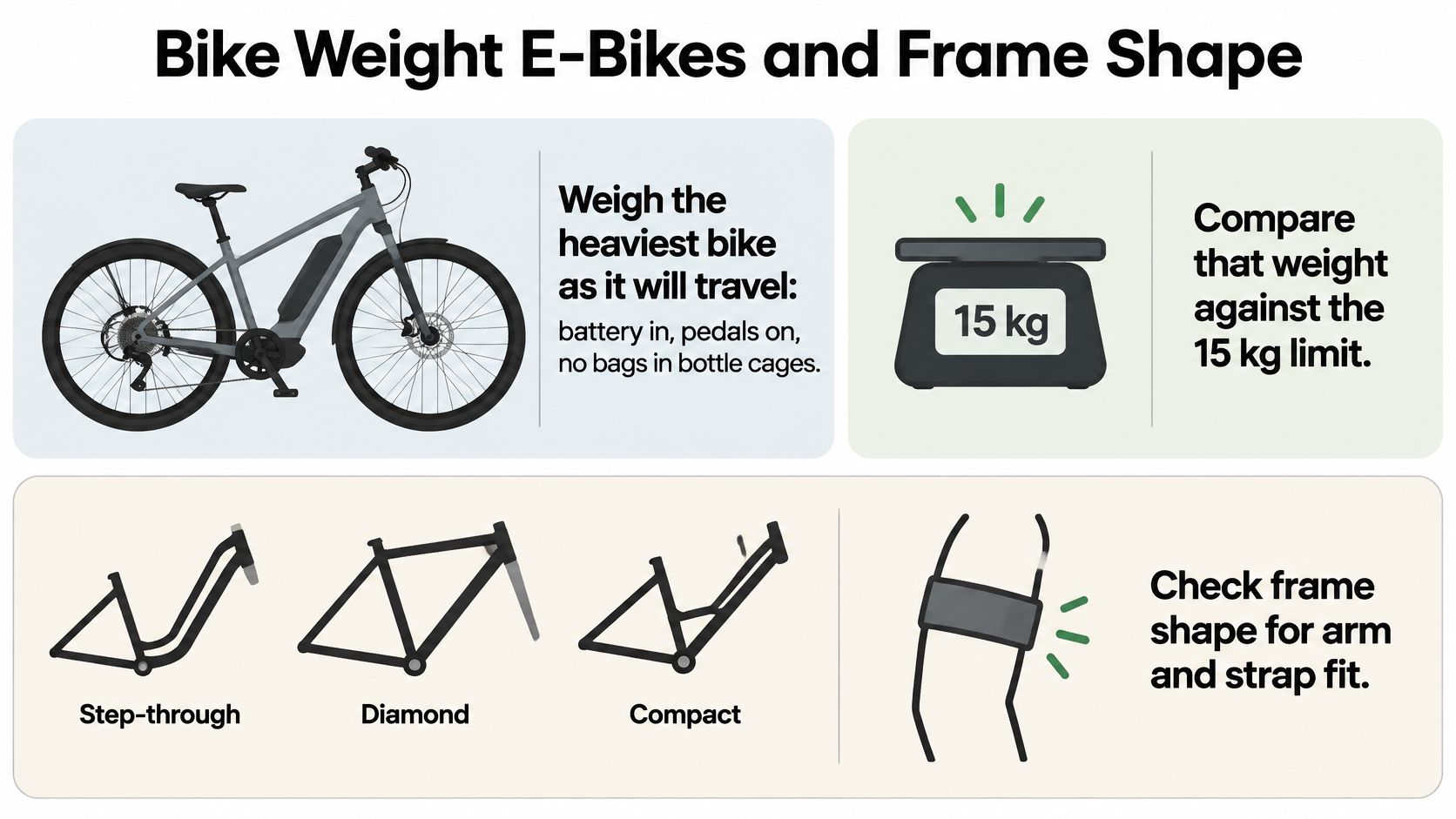
Now put that number against the hanger's ceiling. A light aluminium hardtail, a kids' bike and most commuters clear a hanging rack comfortably. Say the scale reads 14 kg for a trail bike with a tyre insert and a tube taped to the frame; that's close enough to the line to be worth thinking about. Then say it reads 24 kg with the battery locked in, which is where a mid-drive e-mountain bike commonly lands. The hanging row stops being a candidate at that point, no matter how many bikes it claims to hold.
Why the Kilos Aren't the Only Mismatch
Mass is the headline, but shape and width disqualify racks just as fast. Wide 2.4 to 2.6 inch tyres need wheel trays with real spacing between them, or the bikes lean into each other all the way to the trailhead. A suspension linkage, a step-through frame or a carbon tube often gives a hook nowhere safe to sit. Mudguards, a child seat and a rear rack all collide with the neighbouring bike on a tight hanger.
That's the moment the coat-hook logic ends. If the bike has no straight top tube, stop looking at hangers.
Watch this one: the heavier bike and the wider tyre are also the ones most likely to hide your tail lamps and plate, so a platform for e-bikes should arrive with an integrated light board and a number-plate mount rather than leaving you to hope the car's own lamps stay visible, as Waka Kotahi's safe loading guide makes clear for any load that blocks the rear of the vehicle.
Three Worked Calls
- Two 12 kg commuters. Hanging is enough. Check the hanger's per-bike figure, strap them apart, and spend the saved money on a lock.
- One 14 kg trail bike and one 22 kg e-bike. Platform, and the e-bike goes on the tray closest to the car so the heavier mass sits inside the wheelbase.
- Two e-bikes. A rack sold for two e-bikes, not a four-bike hanger running at half capacity. Capacity claims describe hooks, not kilograms.
Take the battery off only if the rack maker says the limit applies to the bike without one. Never quote a lighter number while leaving the battery on the bike, because the load on the ball doesn't care what the spreadsheet says. Our notes on building and carrying a lighter e-bike are useful if you're working the other way and trying to shed mass before you buy.
Loading Lights and Plates Before You Leave
One routine, run in the same order every time, from the driveway rather than from the trailhead.
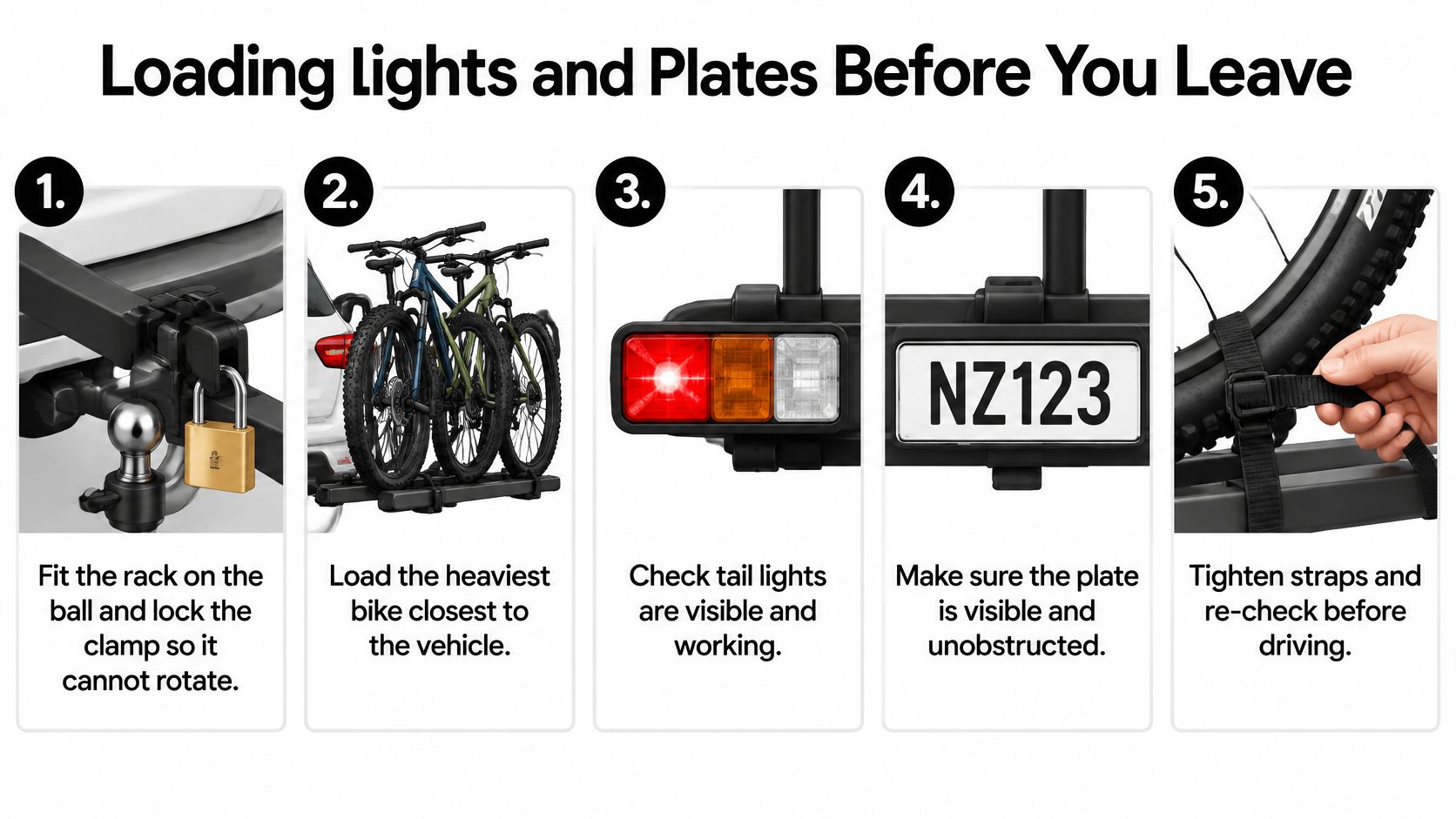
- Seat and lock the clamp. Fit the rack on the ball, then lock the clamp so it can't rotate or creep. An open clamp works loose over corrugations, and the first sign is usually a bike leaning at an angle in the mirror.
- Load the heaviest bike closest to the car. Wheels straight, straps routed exactly where the maker specifies. Add a second strap anywhere the first can slide along a frame tube.
- Keep the bikes apart. Pedals, bars and brake rotors chew through the next frame when they're allowed to touch. Kevin calls the EziGrip Bike Bones an excellent and simple way of keeping bikes separate when transporting them, and a separator does more for a bike's paint than any amount of careful loading.
- Stand directly behind the car. Tail lamps, indicators, brake lights, number plate. Not from the driver's seat, not from a photo. Directly behind, at road height, with the bikes loaded.
- Fit the light board and a readable upright plate if anything is hidden. Then confirm the plug is seated and the lamps work with the car's lights on.
What Changed for Number Plates in January 2026
NZTA's rule is simple to state: plates must stay securely fixed, upright and clearly visible. If a temporary rack hides a plate, you can get a supplementary plate or temporarily attach the original plate to the rack and put it back afterwards. A permanently attached obstruction means the plate comes off the vehicle and goes onto the object.
The January 2026 change made that practical. NZTA introduced supplementary registration plates so drivers no longer had to unbolt and refit the permanent plate every time a rack or a dog box blocked it, as set out in the NZTA number plate rules. For family, e-bike and mountain-bike transport it matters most, because multi-bike racks are exactly the ones that stretch across the plate and lamp area.
| What is blocked | What the driver must do | Rack feature that helps |
|---|---|---|
| Rear number plate only | Fit a supplementary plate, or move the original onto the rack and return it later | Upright plate bracket on the rack |
| Tail lamps, indicators or brake lights | Fit temporary lighting, since cover is only allowed with that lighting in place | Light board plugged into the towbar socket |
| Plate and lamps together | Both a readable upright plate and working lamps on the load | Light board with a plate mount |
| Nothing, checked from directly behind | Original plate and lamps can stay if they remain clearly visible with bikes loaded | Recheck once every strap is tight |
Stop at the first service station or car park and recheck the straps. Vibration loosens cheap buckles faster than anyone expects, and a strap that was tight in the driveway can be flapping by the top of the hill.
Refusal rule: if the plate can't be read from behind or a lamp is dark, the trip waits. That's cheaper than the alternative, every single time.
What Three Real Buying Cases Cost
Three shoppers, the same shelves, three different answers. The price gap has a reason each time.
Case one is a household with two light bikes. A couple of hybrids, or a kids' bike and a commuter, used a few weekends a year with a boot that usually wins the fight. The folding EziGrip Advantage 2 is the rational buy here, provided both bikes sit inside the hanger's limit and the car's plate can be solved with a supplementary plate. Platform money buys convenience in this case, not safety, unless a frame can't take a hook.
Case two is a rider with two e-bikes. Here, the expensive number makes sense. 99 Bikes New Zealand listed the EziGrip E-Volve 2 at NZ$1,385.00 in 2026, and the Yakima JustClick 2 sits in the same band. That's several times the shelf price of a folding hanger, and the difference is tray hardware, a higher load rating and, on a well-specified platform, the light board the wide bikes will need anyway.
Buying the cheap rack and hoping is the expensive mistake. A bent clamp, a cracked carbon tube or a lighting problem that stops the car passing a warrant costs more than the gap between the two racks, and it costs it in the worst week.
Case Three Is Four Riders
A four-bike claim only works when every bike is under the hanger's per-bike limit. Put one e-bike in that group and the case collapses back to a two-bike platform plus a second plan for the remaining riders. Two cars, a borrowed ute, or a shuttle booking.
Buying checks that never appear in a price row matter just as much. A stated kilogram rating on the rack itself. A lock for the ball and a lock for the bikes. A fold that still fits in a Nelson garage with the car parked inside it. Spare straps in the glovebox, because the one that fails is always the one you can't replace on a Sunday.
Freight is a separate line on large items and belongs in the final decision rather than in these rows. A rack is a bulky box, and the shipping cost can shift the arithmetic between two racks that looked close on the shelf.
By now you should be able to name your case out loud. Two light bikes a few times a year is a different purchase from two e-bikes every weekend, and the rack that suits one is wrong for the other.
Pick the Rack That Matches Your Heaviest Bike
Four lines, and each one follows from something already settled.
Buy a hanging tow ball rack only when every bike, loaded as it will travel, sits inside the stated per-bike limit. Treat that limit as a ceiling rather than a suggestion, and treat an unstated limit as a reason to keep looking.
Buy a platform when any bike is an e-bike, has no safe top tube, or runs tyres too wide for the hanger's spacing. Expect to pay in the NZ$1,385 to NZ$1,399 band for a two-bike e-bike example, not NZ$149.
Refuse a rack that can't show a kilogram rating, won't clamp the 50 mm ball without play, or offers no way to carry a plate and lights once the bikes are on.
Don't drive with a blocked plate while waiting for a supplementary plate. Wait for it, or move the original plate onto the rack as the rule allows and put it back when you're done.
Next step before you order anything: weigh the heaviest bike with the battery fitted. That single number decides the style, and no amount of reading reviews replaces it.
Rider 18 in Nelson works on ordinary bikes through to competition bikes and e-bikes in the workshop, sells electric bikes including mountain and commuter types, and can talk through whether a bike's mass and shape suit a hanger before you spend the money. If a shuttle plan needs a loan bike rather than a fourth rack space, there's bike hire as well. Budget freight separately, since large items such as bike racks cost NZ$29.00 per item to ship.
If the weighed bike is over the rack's plate, change the rack. Don't change the story you tell about the bike's weight.
Bring your heaviest bike into Rider 18 at 60 Vanguard Street in Nelson and we'll put it on the scale with the battery in, then match that number to a rack that will carry it, whether that's a two-bike e-bike platform or a simple hanger for the kids' bikes. Our workshop looks after everything from basic models to high-end competition bikes and e-bikes, so the bike and the rack can be sorted in the same visit. Visit Rider 18 to see the racks, e-bikes and workshop services before your next shuttle day.


