

Cycling Nutrition During Ride by the Hour
- by Nigel
-

You're halfway up a Nelson climb, ninety minutes in, and your legs have gone oddly quiet. Your bottle's still mostly water, your pocket's empty, and the café you meant to stop at is further than you thought. That's not a fitness problem. It's a fuelling problem you created an hour ago, and it's fixable with a plan you can set by the clock.
Why Fuel on the Bike Matters
Cycling nutrition during ride time means the carbohydrate, fluid and sodium you take while you're still pedalling. It isn't breakfast, and it isn't the meal you promise yourself at home. Once you're rolling, you're spending from a finite tank.
That tank is muscle glycogen, your body's main readily available carbohydrate fuel. As it falls on a prolonged ride, blood glucose becomes harder to hold steady. Late climbs feel heavier than they should, and your attention slips on roots, ruts and braking points.
A New Zealand-led systematic review of 73 studies reported by Cycling Weekly, conducted by researchers at Auckland University of Technology, found consuming sugar or carbohydrate during exercise improved performance by up to 6%. Treat that figure as an upper-end result across the evidence, not a guarantee for your next loop. It still gives you a measurable reason to carry fuel once duration and intensity rise.
When water alone is enough
An easy spin under an hour often needs only water to thirst. Mountain-bike, gravel, loaded e-bike and windy road days are different because climbing, heat and trail difficulty can lift demand while cafés and taps sit far apart.
You don't need a professional's pantry to respond. A carbohydrate drink, gel, chews, a banana or another ordinary food can all work if you've tested them in training and your stomach tolerates them.
First step to try: On your next ride over an hour, carry one familiar carbohydrate option and start it early instead of saving it for when you're already flat.
Carbohydrate and Fluid Targets by Ride Length
A one-hour chart is a starting point, not a universal script. A short, hard trail ride, an easy spin, and a long gravel day place different demands on your fuel and fluid. Choose the closest row, then adjust for effort, heat and how long you'll be riding.
Carbohydrate and fluid starting points by ride length
| Ride | Carbohydrate per hour | Fluid approach | Typical carry |
|---|---|---|---|
| Under 60 minutes, easy | None needed | Water to thirst | One bottle |
| 60 to 90 minutes, hard effort | About 50 g | Small regular sips | Bottle plus one snack |
| 1 to 2.5 hours, strenuous | About 50 g in small doses | Sips every 15 to 20 minutes; adults adjust to thirst and sweat | Bottle, gel, banana or chews |
| Over 2.5 hours, gut-trained | 60 to 90 g from glucose or maltodextrin plus fructose | Dilute drink plus separate food; do not force volume | Several bottles, real food, electrolytes |
| Children | Below the adult 50 g figure, scaled by age and size | Smaller volumes, guided by thirst | Familiar low-fibre snacks |
Reading the carbohydrate rows
For strenuous rides lasting longer than about 60 minutes, spreading carbohydrate intake through the ride can help you avoid waiting until fatigue sets in. A young-athlete guidance document lists about 50 g of carbohydrate per hour for strenuous exercise exceeding an hour, with lower ranges for children.
That figure is a reference point, not a target to copy onto every rider. For a family ride, choose familiar foods and scale portions to the child's age and size. Allow time to eat and drink safely.
Carbohydrate helps maintain blood glucose and provides fuel from outside the muscle as glycogen availability declines. On a long or demanding ride, that can help you keep working late in the day.
Why two sugars appear in the longest row
For efforts beyond roughly two and a half hours, the table gives a higher range for riders who have trained their gut. Combining glucose or maltodextrin with fructose can increase carbohydrate oxidation compared with using a single carbohydrate source.
Use that higher band only after practising with it. Technical riding can make eating and swallowing harder, so try the foods and drink concentration on a familiar route first.
- Easy and short: Keep it simple with water and ride.
- Hard past an hour: Start carbohydrate early and take it in small doses.
- Long and demanding: Use the higher band only if you've practised it.
- Family riding: Scale the adult figure down rather than sharing it unchanged.
Fluid is a starting point, not a script
Heat, wind, clothing, sweat rate and the distance to the next tap all affect how much you'll want to drink. Take regular small sips and adjust to thirst and how you feel. Carrying enough matters on a remote route, but forcing fluid can be as poor a fit as carrying too little.
If the forecast, route or group pace changes before you leave, change rows before you leave. It's easier to carry a snack home than to find one on a remote gravel road.
Treat the table as a starting point to test in training. If you finish fading, nauseated or desperate for a tap, adjust one part of the plan next time and see how it feels.
Drink Strength Sodium and Thirst
On a hot ride, a strong mix can supply energy, but it may not suit every stomach or riding pace. The Massey University review of 28 studies involving prolonged cycling or running found hypotonic carbohydrate-electrolyte drinks generally produced better central hydration than isotonic or hypertonic drinks, measured by change in plasma volume.
A very concentrated mix can draw water into the intestine and slow its availability. For long, hot rides, a relatively dilute drink taken in small, regular sips may feel easier to manage. If the drink contains little carbohydrate, get more energy from food.
Drink strength and when to use it
| Drink | Tonicity | Best use | Watch-out |
|---|---|---|---|
| Plain water | Hypotonic, no carbohydrate or sodium | Easy rides under an hour, or alongside solid food | No energy; little sodium on long, hot days |
| Dilute carbohydrate-electrolyte | Hypotonic | Long rides in heat when fluid availability matters | Too weak if it is the only carbohydrate source |
| Everyday sports drink near 6 percent | Near isotonic | Mixed fuel and fluid for rides of one to three hours | Taste fatigue; trial it in training |
| Very strong mix or stacked gels in little water | Hypertonic | Extra carbohydrate when other fluid is available | Can draw water into the gut and slow absorption |
How much, and how often
Take small, regular sips and adjust them to thirst, heat and how much you are sweating. There is no single hourly amount that suits every rider or ride. If bottle capacity limits what you can carry between refill stops, a guide to choosing and using a hydration bladder in NZ can help you compare carrying options.
Sodium matters more during prolonged rides or heavy sweating. More fluid is not automatically safer: aim to limit excessive body-mass loss without finishing substantially heavier from drinking.
The overdrinking risk
In a study of an ultra-endurance cycling race in New Zealand, 18 cyclists averaged 0.58 litres per hour of fluid intake. After the race, 7 of 18 riders, 39%, had blood sodium at or below 135 mmol/L, including one rider at 132 mmol/L; only two appeared moderately dehydrated. The study, published in the European Journal of Sport Science, recorded what those riders drank. The average is not a personal target.
Drinking beyond fluid losses can contribute to low blood sodium, or hyponatremia. Watch for nausea, bloating, a sloshing stomach, swollen hands or feet, and unusual confusion or drowsiness late in a ride. Stop forcing fluid if these signs appear, and seek medical help promptly if symptoms are severe. Don't chase an empty bottle for its own sake.
Carrying and Eating Without Stopping
Food only helps if you can reach it without a wrestling match. Set up your bike so the next dose is obvious, openable with gloves on, and safe to eat on the terrain you're riding.
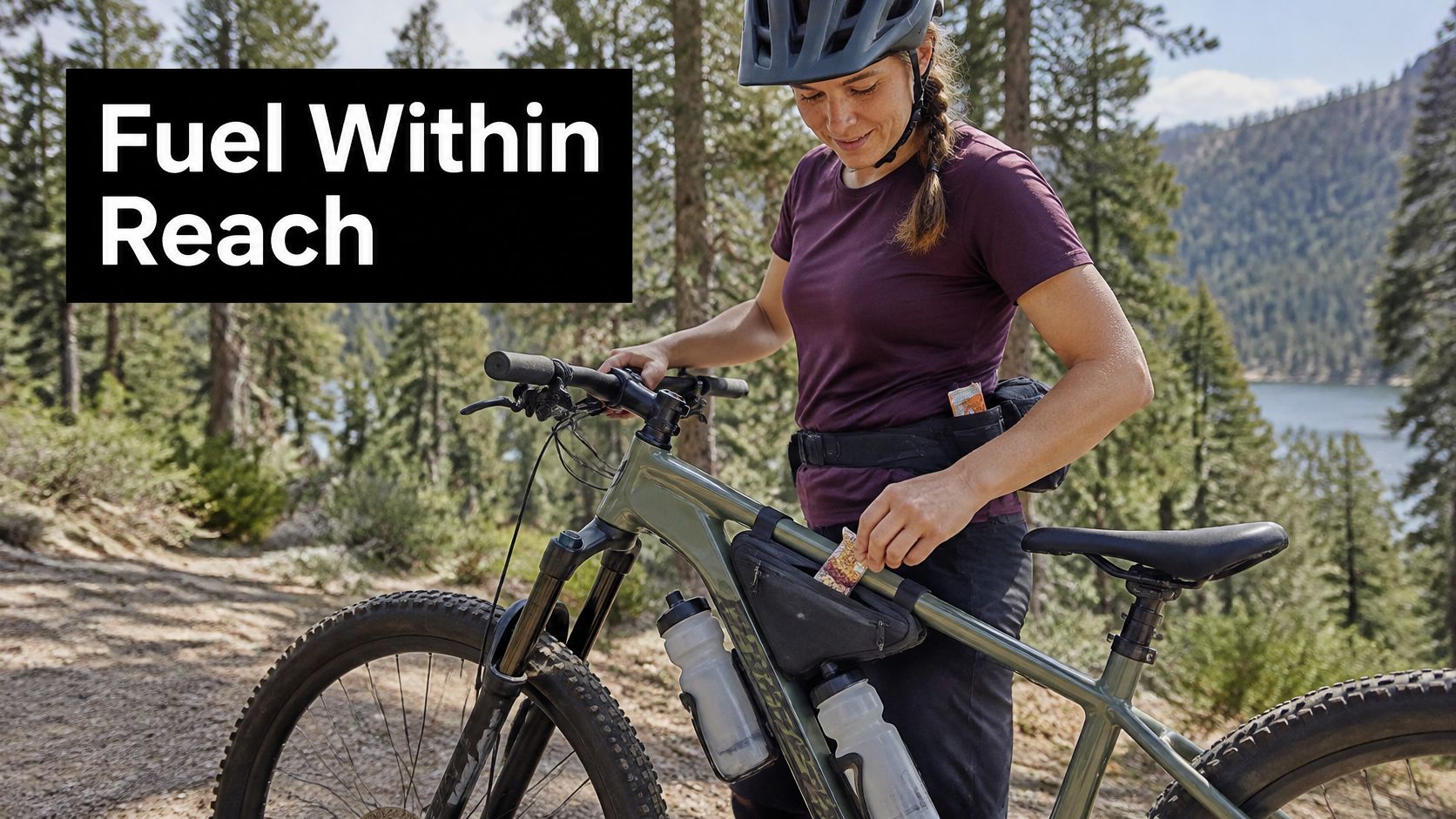
This rider shows the basic principle, food stored where a hand can find it during a brief pause on the trail.
Put fluid and food in different jobs
One bottle cage is rarely enough past two hours. Add a second cage where the frame allows it, then use a hip belt or small frame bag for the food you don't need in the next few minutes. Keep water on the frame where you can grab it without looking down for long.
Soft flasks in a jersey pocket suit drink mixes because you can squeeze them one-handed. They're also useful when a hard bottle rattles or when you want plain water in one place and mix in another.
- Easiest pocket: The next item you'll eat.
- Frame bag or hip belt: The rest of the hour and your backup.
- Deep storage: Emergency food you hope not to need.
- Small separate pocket: Wrappers, so they don't end up on the trail.
Prepare packaging before you roll
Pre-tear gel tabs and unwrap bars at home, then reseal them loosely in a pocket or small bag. Gloves, sweat and a moving bike make factory packaging harder than it looks at the kitchen bench.
Choose low-fibre foods that travel well, such as banana pieces, rice cakes, chews or a white-bread jam bite. A large sandwich can work on a relaxed tour, but it's awkward to portion on singletrack. If you're building a full carry list, this overview of what to bring on a bike ride covers the wider kit beyond food and bottles.
The short video below is useful for checking how your carry setup works in motion rather than in the driveway.
Choose your eating moments
On a mountain bike, eat on a fireroad, a smooth link trail or at the top of a climb. Don't try to chew through a braking zone or a rock garden. Family riders should pack food a child already tolerates and a bottle the child can grab without stopping the whole group in an awkward spot.
E-bike riders need the same discipline. Assist stretches the day and can make the early hills feel deceptively cheap. Your legs are still spending fuel, so keep the next dose within reach.
Carry map: The next 20 minutes in your easiest pocket, the rest of the hour in your bag, water always on the frame.
How to Time Food Across the Ride
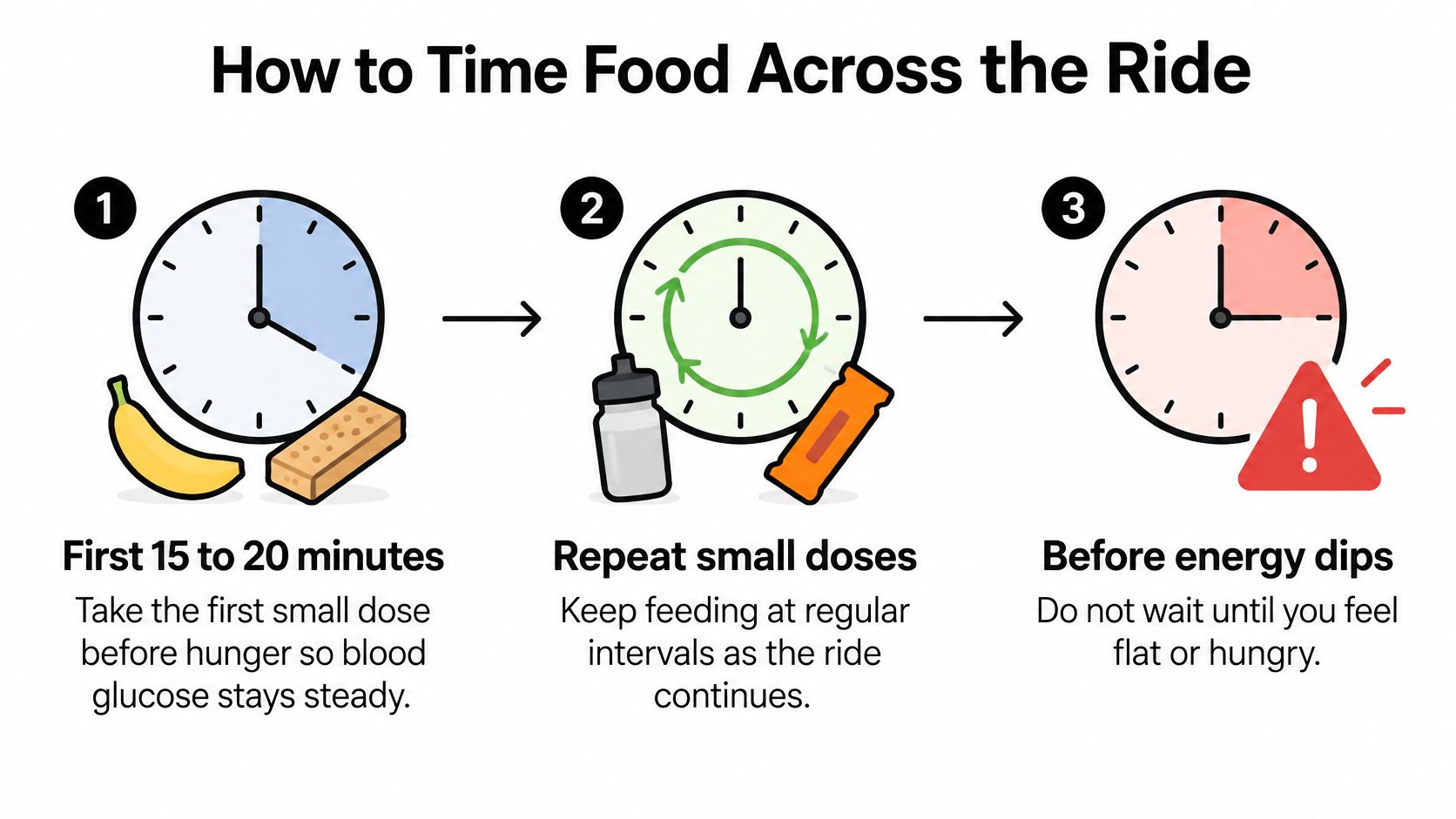
Timing turns an hourly target into something your stomach can handle. You're not choosing new gram targets here. You're dividing the amount you've already selected into small, repeatable doses.
The sequence below keeps the pattern simple enough to follow when you're tired.
A clock you can follow
- Start in the first 15 to 20 minutes. Take the first small dose before hunger arrives, so blood glucose stays steadier as glycogen use climbs. Waiting until you feel flat means you're spending the hour you meant to protect.
- Repeat every 15 to 20 minutes. Small and regular beats one large feed each hour. A full gel plus a dense bar at once is a common cause of sloshing and stomach protest.
- Pair a sip with every bite. Fluid with food keeps the mix closer to a drinkable concentration. Don't wash several concentrated items down with barely a mouthful of water.
- Use the next smooth section on technical trail. Chewing through rough ground costs focus and often costs you the food as well. Wait for a fireroad, seal or gentle climb where one hand can leave the bar safely.
If gels are part of your rotation, compare flavours and formats in this guide to energy gels available in NZ before you commit to a box. Whatever you choose, it has to be easy to open and tolerate at riding intensity.
Past two hours, simplify the cue
- Switch to one reachable item per quarter hour. By now, unpacking a bag for a complicated feed is friction you don't need. Keep the sequence in your easiest pocket and refill that pocket at planned stops.
- Shrink the dose if your stomach protests. Stretch the gap slightly and move to a familiar low-fibre option. Don't introduce a new product mid-ride to solve a problem created by dose size.
- Check the result late in the ride. Steady effort, no sudden hunger crash and no urgent stop suggests the spacing fits. A sloshing stomach points to doses that were too large or too concentrated, while a sharp fade points to starting too late or missing feeds.
Common timing mistakes
- Saving food for the big climb: You'll be breathing too hard to eat much once you're on it, so feed on the approach.
- Eating only at viewpoints: Scenic stops rarely arrive every quarter hour, and your fuel needs don't follow the photo schedule.
- Skipping because you feel good: Feeling good at minute forty is not evidence you'll feel good at minute one hundred.
- Catching up in one hit: Two missed doses swallowed together are harder on your gut than returning to small doses.
Set a watch or head-unit reminder if you forget. It's not a lack of toughness to use a beep. It's a practical guard against the most predictable mistake in cycling nutrition during ride planning, drifting past the point where a small dose would've kept you steady.
When Eating Less Helps or Hurts
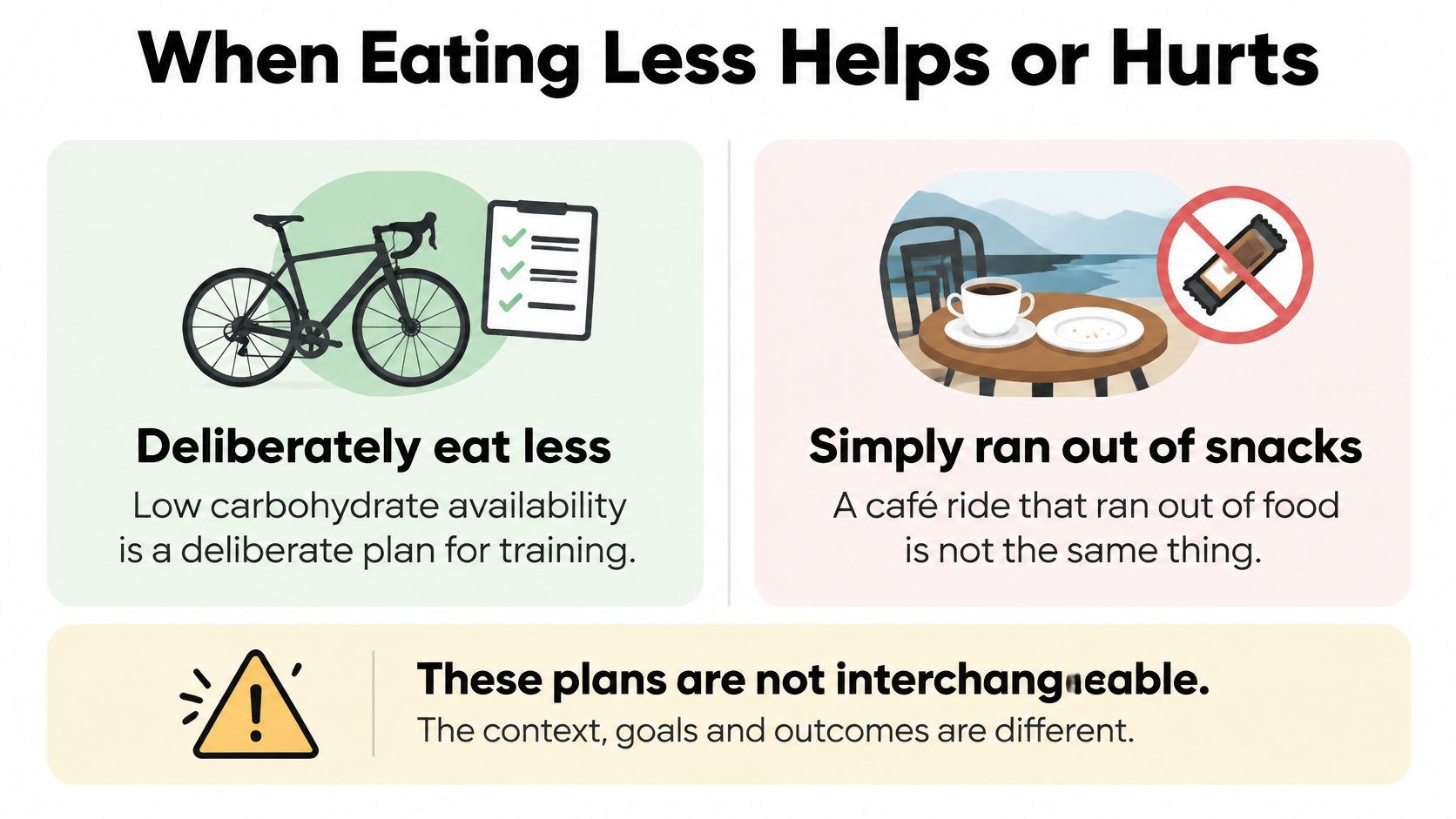
One carbohydrate target for every ride is a poor script. A commuter spin, a family loop, a short sharp trail session and a long alpine day ask different things of you. Eating less can be a deliberate training choice, but it isn't the same as a café ride that ran out of snacks.
The comparison below separates a planned session from an accidental shortage.
What low availability can cost
NZ-based research in an AUT thesis on carbohydrate availability found power at the first ventilatory threshold was 133 ± 24 W with low carbohydrate availability compared with 152 ± 28 W under high carbohydrate availability, a reduction of 19 ± 14 W. Lactate-threshold power didn't fall in that comparison.
That pattern matters because the cost can be subtle and effort-dependent. You might still produce a hard effort while the steadier work underneath it becomes more expensive. Don't assume that finishing the ride proves the low-fuel choice cost you nothing.
Match the choice to the ride
An easy social ride under an hour may need no carbohydrate beyond normal meals and water to thirst. A short high-intensity trail session can still justify a small early dose if you're backing up efforts or riding again later. Those are ordinary pacing decisions, not a formal low-carbohydrate intervention.
A long alpine or gravel day is the wrong place to experiment. Navigation, weather, descents and limited shops already give you enough variables. Fuel that ride properly and keep your attention for the terrain.
Training low is an advanced, scheduled strategy for riders who already fuel hard days well. It should be planned around an appropriate session, with food available if you need to end the experiment. Starting a demanding ride underfed because you forgot breakfast isn't training low, it's just starting late.
Who shouldn't start under-fuelled
- Children: Their needs should be scaled and supervised, not restricted as a training tactic.
- Riders with medical conditions affecting glucose: Get individual medical advice before manipulating carbohydrate.
- Anyone prioritising safety or enjoyment: Technical descents, group responsibility and remote routes all argue for adequate fuel.
- Riders learning basic fuelling: Learn to meet the target first before you deliberately depart from it.
Recent NZ-linked work on New Zealand blackcurrant supplementation and fat oxidation in endurance cyclists is experimental. It doesn't replace carbohydrate on demanding rides. If a product sounds like a shortcut around eating enough, treat that claim with caution.
Deliberately eating less is a session you schedule. Running out of food is a logistics failure. Don't rename the second one to make it sound like the first.
Fuel Plans for Real Ride Days
Apply the same order each time: who is riding, how long, what changes the plan, and what not to copy from someone else. The scenes below use the targets and timing you've already selected rather than inventing a new chart.
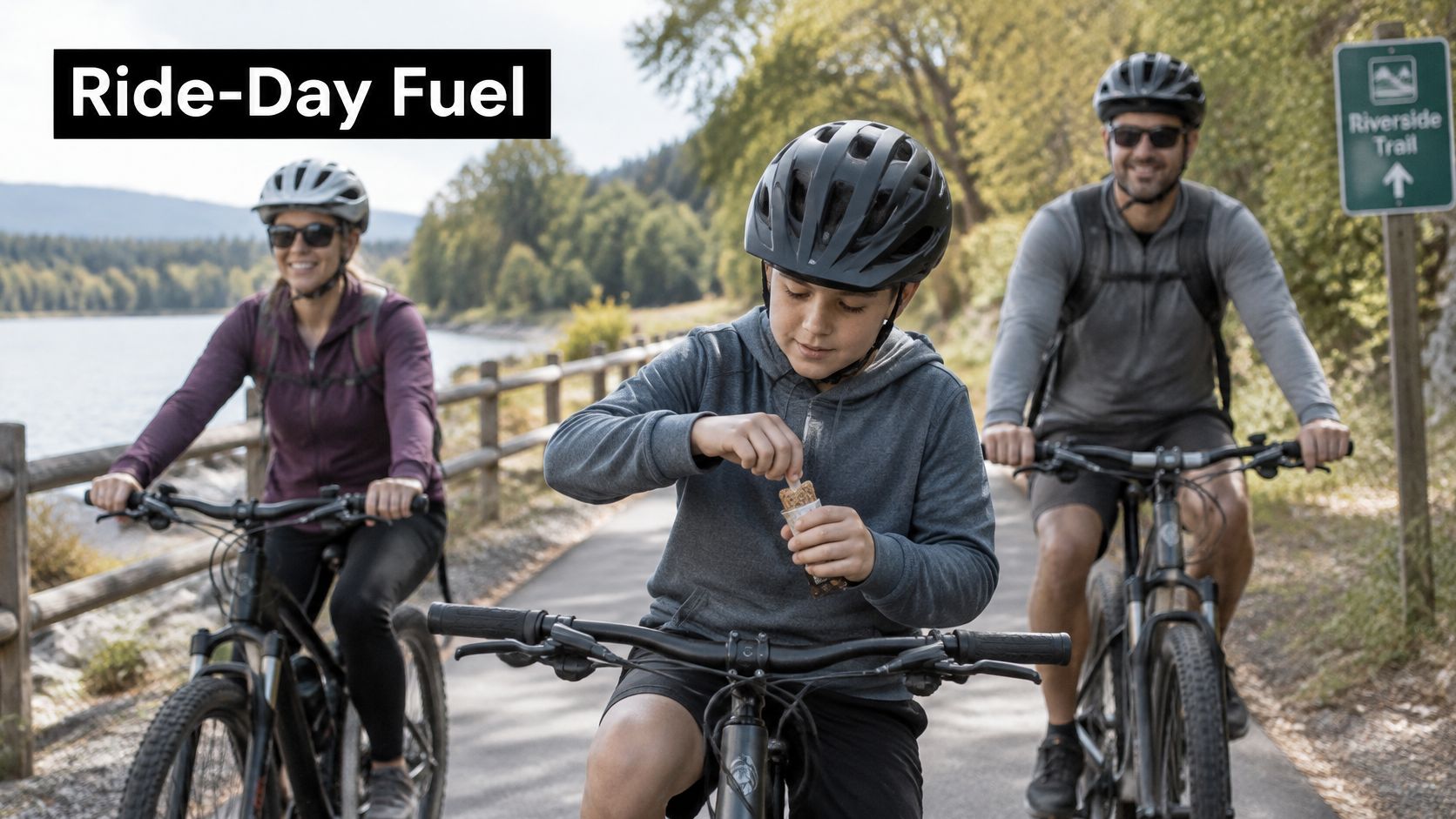
A family ride shows why the simplest plan is sometimes the right one.
Four rides, four answers
Saturday family loop, under an hour. You're on easy paths with a child and plenty of chances to stop. Carry water to thirst and a familiar snack in case someone's hungry. Don't force an adult gel target onto a child or turn a relaxed loop into a feeding schedule.
Ninety-minute trail or skills session, hard pace. The effort is shorter but sharper, with repeated climbs and technical sections. Start a small carbohydrate dose early, keep the bottle dilute, and save chewing for climb transitions or smooth links. Don't copy the family loop just because both rides fit inside a morning.
Four-hour gravel or bikepacking leg. Wind, climbing and few shops make missed feeds expensive. Begin in the first 20 minutes, carry electrolytes, name your refill points before leaving, and use glucose plus fructose toward the higher band only if your gut is trained for it. Don't rely on finding a dairy at the exact moment you fade.
E-bike explore day. The motor flattens early hills, so the ride gradually becomes longer than your legs expected. Fuel the rider, not the battery. Duration still empties glycogen, especially once assist drops or the climbs steepen.
What the long-ride evidence adds
In a 2024 AUT study of 12 trained New Zealand cyclists and triathletes, participants completed 150 minutes of moderate-intensity cycling, and carbohydrate ingestion maintained power at the first ventilatory threshold at 225 ± 36 W compared with 216 ± 35 W without carbohydrate.
That's a modest, specific gap. Fuel protects the last hour, it doesn't transform an easy one. Use it as a reason to be consistent on long days, not as permission to add gels to every short spin.
Practise the Plan Before You Rely on It
Pick one training ride close to the length and terrain of the day you care about. Match the climbs, heat and stop points as closely as you can, and pack only foods you already tolerate.
Write down the clock time of each dose, how much you finished, and whether your stomach, thirst or late-ride power complained. That record is more useful than remembering that the ride felt “pretty good”.
Change one thing next time, dose size, drink strength or where food sits on the bike. Once that version works, copy it onto the event day without debuting a new gel on a group ride or a child's first long family outing.
Buy bottles, soft flasks, chews or electrolyte mix before the rehearsal, not on the morning of the event. For broader context on supplements alongside food and fluid, read this sports nutrition advice for New Zealand cyclists and keep the basics, carbohydrate, fluid and sodium, at the centre.
Your checklist is short. Write the hourly row, practise it once, adjust it once, then ride.
Before your rehearsal ride, visit Rider 18 for bottles, cages, hydration, frame bags and ride nutrition you can test in training rather than debut on the big day. The Nelson team can also help you match carry options to your mountain bike, gravel bike, e-bike or family setup, so your food and fluid stay within reach when the trail gets busy.


