

MTB Suspension Grease: Where It Belongs
- by Nigel
-

“Put some grease on the stanchions” sounds like sensible advice for a sticky fork. It isn't. An exposed coating can hold grit against the wiper, while the actual problem may be a dirty foam ring, unsuitable air-spring lubricant or overdue oil service.
MTB suspension grease belongs at specific internal interfaces, not on every moving surface. The useful question isn't which tube promises the smoothest ride. It's which part you're servicing, what lubricant its manufacturer specifies, and whether you've removed the contamination first.
Where MTB Suspension Grease Belongs
Where suspension grease goes and where it does not
| Part | Correct product | How much | If you use the wrong one |
|---|---|---|---|
| Wiper lips and dust seals | Specified suspension grease | Thin film on approved surfaces | A bead traps grit as abrasive paste |
| Foam rings | Specified suspension grease where required, plus prescribed oil preparation | Light coat only when instructed | A dry or incorrectly prepared ring contributes to stiction and poor oil retention |
| Air-spring seals, glide rings and piston | Grease named in the service manual | Film only, unless otherwise specified | Thick bearing grease can bind the air spring |
| Bushings when the maker specifies grease | Low-drag grease from that manual | Smear, not a packed pocket | Incorrect lubrication creates excess drag or early wear |
| Pivot cartridge bearings | Bearing grease or the specified grease | Manufacturer's fill specification, balanced against drag | Overfill adds drag, mess and seal bleed |
| Exposed stanchion | No grease; wipe clean and dry | None | Grease becomes a dirt paste at the wiper |
| Lower-leg bath | Specified bath oil | Measured service-manual volume | Grease cannot provide the intended splash lubrication |
| Damper circuit | Specified damper fluid | Service-manual volume and bleed procedure | Grease interferes with valving and damping |
The distinction is practical rather than cosmetic. Electric MTB UK's grease guide separates suspension applications such as seals, foam rings and air-spring components from bearing lubrication, and warns that ordinary bearing grease can be too thick for an air spring.
Start by identifying the component, not by choosing a familiar tub. A fork's dust wiper, air piston and lower-leg oil bath sit close together, but proximity doesn't make their lubrication requirements interchangeable.
Seals need lubrication without a reservoir of dirt
At an approved wiper lip, a thin film lubricates the sliding contact between rubber and stanchion. A substantial bead doesn't improve that contact. It leaves surplus material that can migrate towards dirt outside the fork.
Foam rings need particular care. Many service procedures require them to be soaked in the specified oil; some also call for grease at associated seal surfaces. Don't interpret a general grease chart as permission to replace that oil preparation with a coating from a tube.
Air-spring seals and glide rings are another separate job. Their lubricant must suit both the seal material and the sliding interface. A stiff product that works well inside a loaded bearing may make the air piston reluctant to start moving.
Practical rule: A lubricant being suitable somewhere on your bike doesn't make it suitable inside your fork.
Bearings are a different decision
Pivot cartridge bearings carry loads through rolling elements and races. Their fill level involves a trade-off between contamination protection and drag, rather than the thin-film approach used on a sliding seal.
Don't respond to a sticky fork by immediately changing air pressure. Once you've established that the suspension moves correctly, use a suspension sag setup guide to assess spring support separately from friction.
Before opening the lowers, find the exact part in the chart and locate its lubricant specification in the correct service manual. If you can't identify both, stop before disassembly.
How Suspension Grease Differs from Oil
Think of grease as oil held in a sponge-like thickener. The thickener keeps the lubricant near a contact point while releasing oil as surfaces move. The analogy isn't exact, but it explains why grease stays where a free-flowing liquid would run away.
A sliding suspension seal is a little like a door seal moving against its mating surface. It needs lubrication at that contact, not a cavity stuffed with paste. More material around the seal doesn't necessarily make the movement easier.
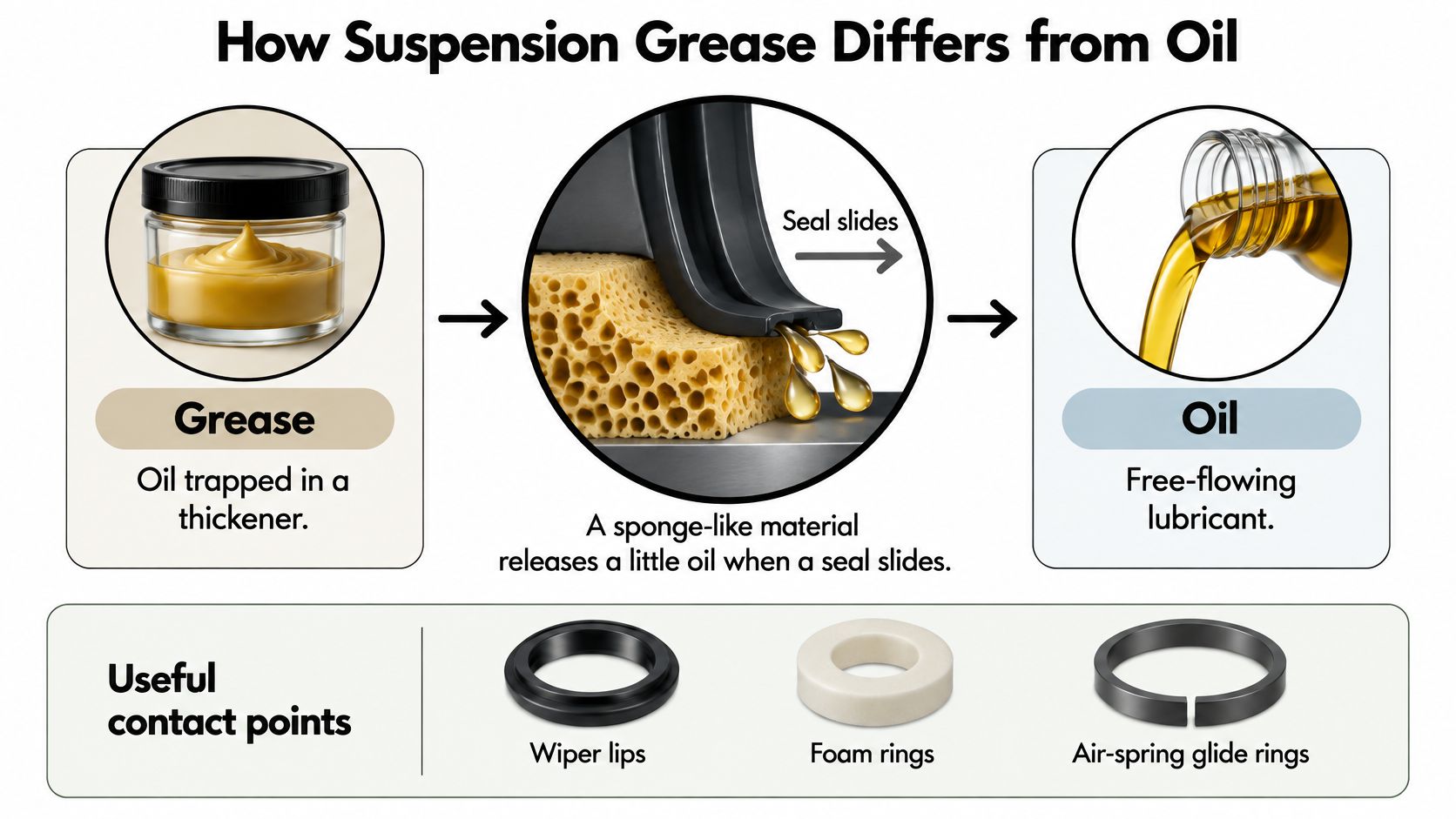
A fork service with similar-looking containers
Say you're preparing a fork for a lower-leg service. On the bench are a grease pot, a bottle of bath oil and a bottle of damper fluid. They're all lubricants, but their jobs are different.
The grease stays at specified assembly and sliding contacts. The bath oil moves within the lower legs, helping lubricate the bushings and maintain the intended oil supply around the foam rings. It needs to flow as the fork moves.
Inside the damper, fluid passes through controlled passages and valves. That resistance controls how quickly the suspension compresses and returns. Damper fluid therefore has a hydraulic job, not a general lubrication job.
Grease stays near a contact. Bath oil distributes lubrication. Damper fluid controls movement.
Why a bearing grease can feel wrong
Bearing grease is formulated for rolling contacts under load. On an air piston, an unsuitable consistency can increase breakaway friction, the resistance you feel before the suspension starts moving.
A rider may describe that as notchiness or assume the air pressure is too high. Letting air out changes spring support, but it doesn't correct the lubricant at the seal.
Headset and general-assembly products are separate again. A grease suitable for a headset bearing or an approved threaded interface hasn't automatically been assessed for suspension elastomers, coatings or internal fluids.
Before starting, you should be able to identify these without guessing:
- Suspension grease: The exact product approved for the relevant seals or assembly surfaces.
- Bath oil: The specified lubricant for the lower-leg bath, with a measuring tool ready.
- Damper fluid: The specified hydraulic fluid, reserved for the appropriate damper service.
If the labels don't establish those roles, don't pour or apply anything.
Matching Grease to Seals and Weather
Find the lubricant specification on your fork or shock service sheet before comparing products. Match any named product exactly, or use an alternative only where the manufacturer permits a clearly defined specification. A label saying suitable for bikes isn't enough.
Standards New Zealand identifies ISO 6743-9 as a classification system for greases used in equipment, machine components and vehicles. Classification helps describe a lubricant, but it doesn't replace approval for your suspension assembly.
Checks before a grease touches a suspension seal
| Check | Accept | Reject |
|---|---|---|
| Base oil | Stated, with compatibility confirmed for the fork oil and coatings | Unknown oil or a mixture the manual forbids |
| Thickener | An approved system applied after old grease is removed | Mixing families without verified compatibility |
| Temperature | A stated range covering expected cold starts and operating conditions | A range that excludes your riding conditions |
| Water resistance | Documented resistance to washout, alongside suspension suitability | No water-resistance information or only a generic multipurpose claim |
| Seal compatibility | Explicit suitability for the relevant elastomers, O-rings and coatings | Assuming bearing-load performance proves seal compatibility |
| Quantity | Thin film or the amount shown in the assembly instructions | Packing an air chamber or introducing grease into a damper |
Read chemistry before marketing
Base oil describes the lubricating fluid within the grease. Its compatibility matters because it may contact suspension oil, coatings and seal materials during use. If the product information doesn't answer those questions, ask the component manufacturer rather than assuming that all suspension products mix safely.
The thickener matters too. Incompatible systems can soften, harden or separate oil when mixed. Adding a new product over an unidentified old smear leaves you with an unknown blend, even if the new grease itself is appropriate.
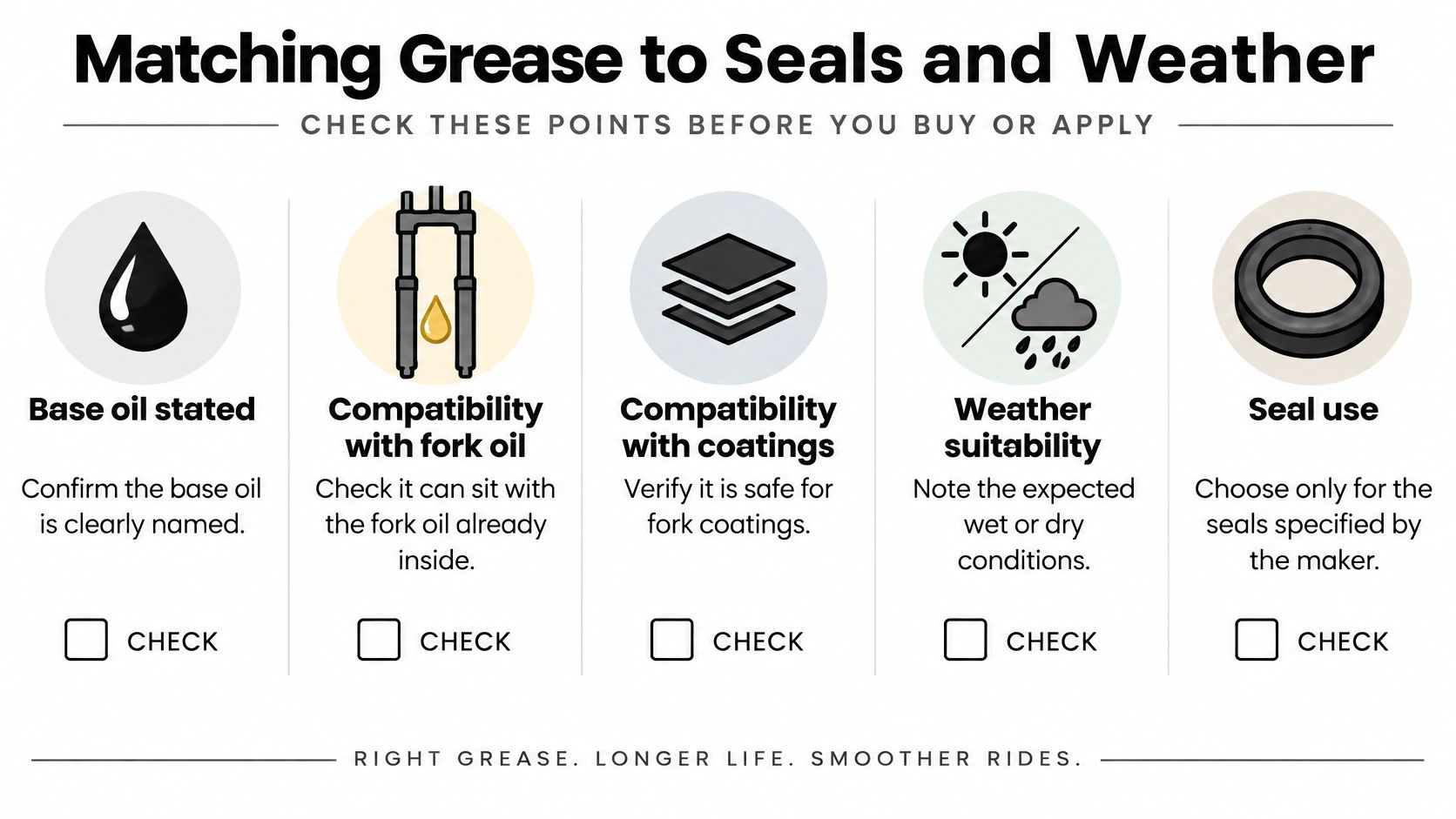
Compare the actual operating job
For Nelson riding, assess wet-weather protection alongside low drag and stable consistency. A heavy grease that resists water in a loaded bearing may still be unsuitable for a lightly sliding air-spring seal.
Temperature suitability is another check, not a promise of better suspension. A broad operating range doesn't establish how a contaminated fork will feel after a muddy ride.
E-bikes add another reason to keep applications separate. Added mass and drive torque can increase pivot loading, but that doesn't justify applying more grease to an air piston or exceeding a bearing's assembly specification.
Finish with a repeatable workshop habit:
- Clean: Remove the previous lubricant using the manual's approved method.
- Inspect: Look for water, rust, metallic contamination and damaged sealing surfaces.
- Record: Write down the product used and the work completed.
That service note lets the next person identify the chemistry instead of guessing from the colour of an old residue.
Applying a Thin Film the Right Way
This is a preparation and lubrication sequence for an approved lower-leg or air-sleeve service, not a universal disassembly procedure. Use the exact fork or shock manual wherever its instructions differ. Don't open a damper or charged reservoir as part of this job.
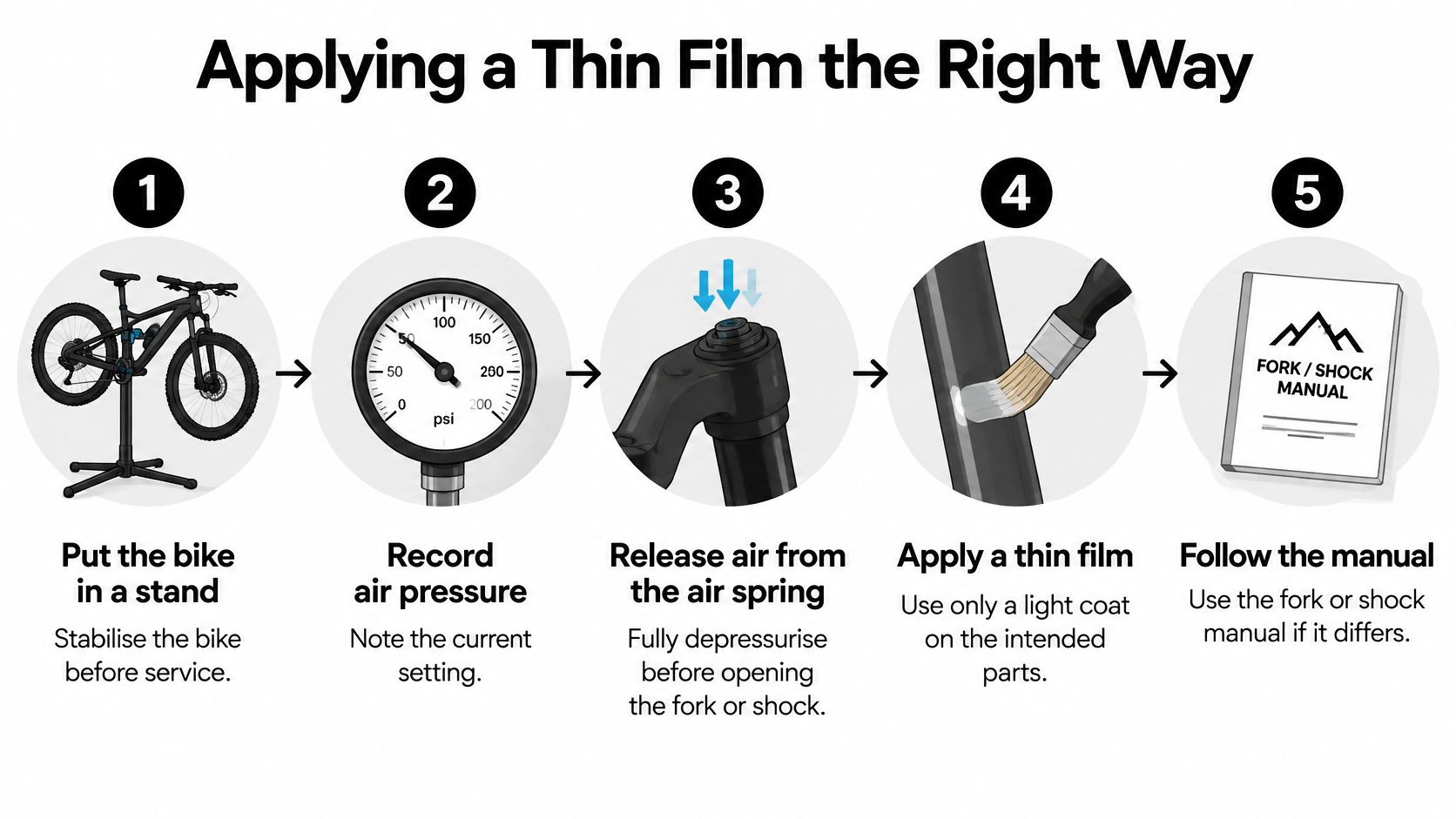
Prepare before loosening anything
Have a shock pump, oil-catching tray, lint-free cloths, nitrile gloves, the specified tools, a torque wrench and a suitable oil-measuring syringe ready. Keep brake pads and rotors protected from lubricant.
- Secure the bike and make the air spring safe. Record the current air pressure, then depressurise using the manufacturer's procedure before opening the assembly. Some designs require cycling or additional pressure-release checks, so a zero reading alone isn't a universal guarantee that every chamber is empty.
- Remove the lowers or air sleeve with the specified tools and sequence. Catch drained bath oil in a clean tray so you can inspect it and keep it separate from grease, cleaning fluid and fresh oil. If a component resists removal, don't force it or assume pressure has fully released.
- Remove residue and inspect the parts. Use a lint-free cloth and approved cleaner to remove old grease from accessible seals and the air piston. Torn lips, rust, scoring or metallic paste need investigation before reassembly; fresh grease won't repair a damaged surface.
- Prepare the foam rings exactly as the service manual describes. Clean or replace them as instructed, allow approved cleaner to evaporate where required, and soak them in the specified oil when directed. Don't leave an oil-fed foam ring dry just because nearby surfaces receive grease.
Apply and rebuild deliberately
- Spread the specified lubricant only on approved surfaces. Use a clean gloved finger or small brush to leave a continuous film on the instructed wiper lips and air-spring seals. Treat foam rings according to their particular procedure, and remove blobs that could migrate during assembly.
- Refit the components, add the measured bath oil and tighten fasteners to the service-sheet torque settings. Fit replacement crush washers, seals or other single-use parts where required. An approximate pour or reused sealing part can undermine otherwise careful work.
- Repressurise and check operation. Inflate and equalise the air spring according to the manual, then cycle the suspension and check for leaks or abnormal resistance. Wipe away residue that reaches the exposed stanchion and record the lubricant used.
For bench organisation and wider cleaning habits, use this professional bike-maintenance guide alongside the component-specific service instructions.
Stop-work check: If the assembly remains shortened, binds or behaves differently after servicing, don't ride it to see whether it frees up. Resolve the fault first.
Wet Trails and the Waterproof Claim
After a wet descent, you wipe the fork and find grey paste around the wiper. Say you'd previously coated the stanchion with grease. That residue may be trail grit held in the surplus lubricant, so the immediate response is gentle cleaning and drying, not another layer.
In another case, an air spring feels reluctant to extend after servicing with thick bearing grease. Unsuitable lubricant may be contributing, but a shortened or stuck-down assembly also needs pressure and assembly faults ruled out. Don't force it open or assume a different tube is the complete diagnosis.
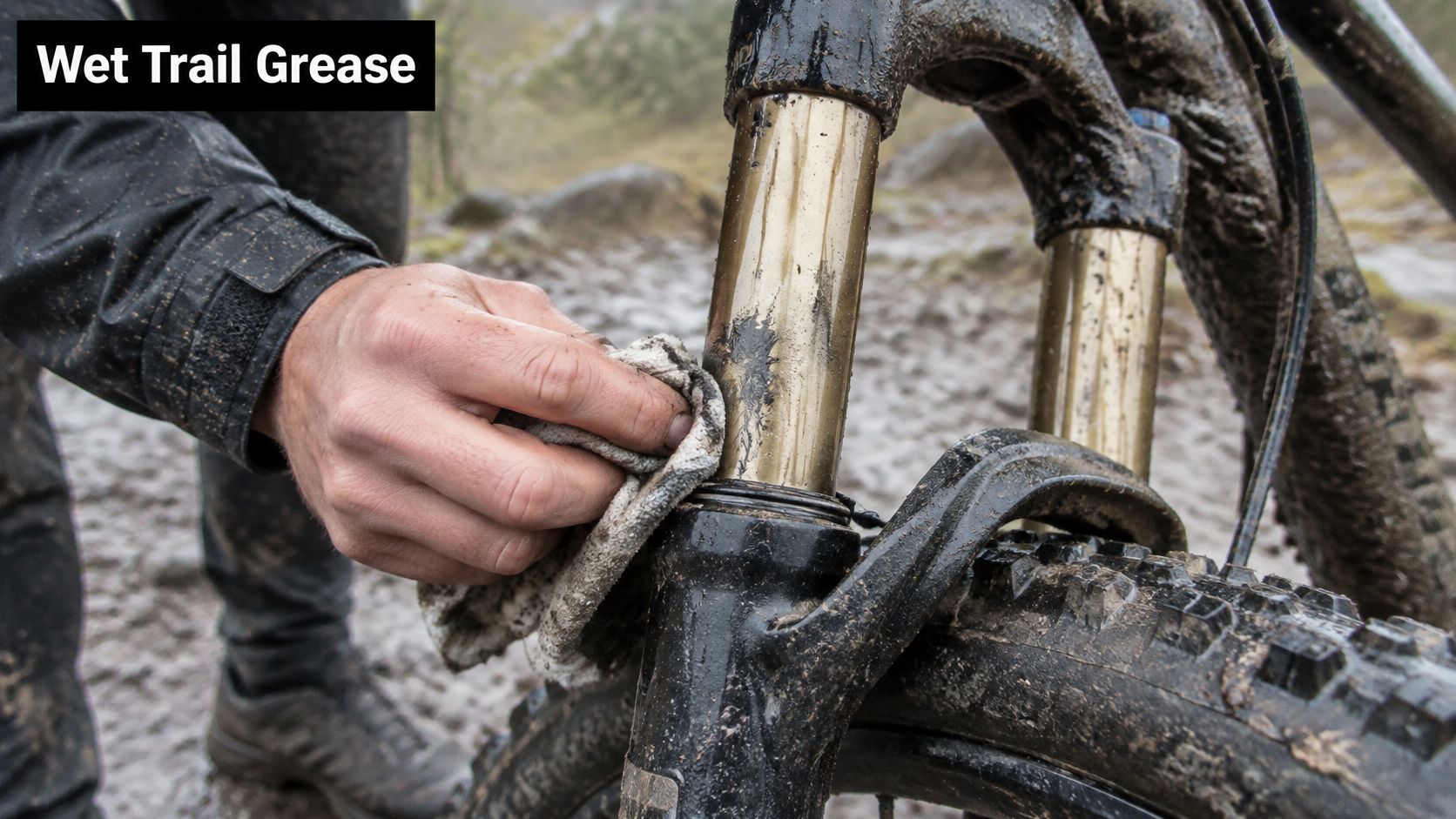
Water resistance isn't maintenance
Nelson's monitored catchments receive approximately 1,000 mm of rainfall annually, according to Nelson City Council's environmental reporting.pdf). Water can displace unsuitable grease, contribute to emulsification and encourage corrosion, making an approved water-resistant, corrosion-inhibited formulation a sensible requirement.
Does waterproof grease eliminate cleaning and lower-leg service? No. It cannot repair a torn wiper, clean a contaminated foam ring or restore the correct bath-oil condition.
Bikelab Studio's discussion of suspension-grease tribology describes a formulation with a stated -30 to 110°C operating range and claimed compatibility with elastomers, O-rings, fork oils and coatings. Those specifications don't establish how much improvement you'll feel after repeated grit and water exposure.
- After wet rides: Gently remove mud, then clean and dry the stanchion and seal area.
- If contamination returns: Inspect and service the assembly rather than repeatedly wiping away symptoms.
Buy or Book the Right Fix
For a wiper or air-spring job, buy suspension grease only after checking the exact manual and compatibility information. For a headset or general assembly task, choose the lubricant intended for that interface instead. Match the part first, then the chemistry, then the price.
In its 2026 listing, Evolution Cycles priced Peaty's Suspension Grease at NZ$39.00. Its 2026 listing for Chris King Blue Grease was NZ$34.99, with the product page describing headset and general-assembly use, rather than identifying it as a dedicated suspension grease.
Choose the job you can complete properly
- Buy for a defined service: You have the correct manual, approved lubricant, replacement parts and tools, and understand the pressure-release procedure.
- Book for diagnosis or unfamiliar work: The suspension binds, leaks, remains shortened or needs disassembly beyond your experience.
A mountain-bike suspension servicing guide can help you distinguish routine lower-leg lubrication from work that needs a specialist.
Before the next wet ride, identify the service your suspension needs and either prepare the correct materials or book it in. A fancy tube can't replace cleaning, inspection or a sound seal.
Rider 18 offers suspension servicing and workshop advice in Nelson, including help identifying the correct lubrication job for your fork or shock. Visit Rider 18 with your suspension model and a description of the symptoms to discuss the right service before your next wet ride.


