

E Bike Battery Repair
- by Nigel
-

Lithium-ion battery fires in New Zealand more than doubled between 2020 and 2024, rising from 51 incidents to 120, according to Fire and Emergency New Zealand figures collated by RNZ. That count covers every product with a lithium cell inside it, from vapes and power banks to e-bikes, so it isn't a measure of e-bike failures on its own. It is the backdrop every battery decision now sits against.
Most packs that arrive at a workbench are not emergencies. A few are, and the whole skill of e bike battery repair is telling one from the other before anything gets plugged in, opened or dropped in a bin.
Battery Symptoms and What Each One Means
Riders rarely arrive with a precise diagnosis. They arrive with a story: the range isn't what it was, it cut out on the bridge, the charger keeps blinking. Underneath all of it sits one question worth answering before anything else. Can this pack be recovered, or does it need to come out of service today?
Sorting that is most of what the job involves. The table below matches seven common symptoms to their likely cause, the response that belongs in the next ten minutes, and the route that follows.
E-bike battery symptoms, likely causes and immediate responses
| Symptom | Likely cause | Immediate response | Repair route |
|---|---|---|---|
| Range drops quickly over months | Cell ageing or capacity loss | Keep charging normally, log cycles | Capacity test at a workshop |
| Hot to touch during or after charging | Cell fault, faulty charger or an internal short | Stop charging, move the pack to a clear area | Quarantine and specialist inspection |
| Swelling or a bulging case | Gas build-up from cell damage | Stop use and charging, don't open the case | Specialist assessment or disposal |
| Cut-outs or power loss under load | Loose connector, battery-management-system trip or a failing cell | Check the connector and terminals for corrosion, don't force anything | Workshop diagnostic |
| Water in the case or corroded terminals | Seal failure and moisture ingress | Stop use, don't dry the pack with heat | Specialist inspection, often replacement |
| Charger lights blink or the pack won't start | Charger fault or battery-management-system lock-out | Test with the original charger on a known-good outlet | Diagnostic test before any pack work |
| Cracks, a puncture or a chemical smell | Physical damage | Don't open, charge or bin it | Emergency handling with council or specialist advice |
Work down the column that fits your case and the decision usually makes itself. Rapid capacity loss over months is the ordinary one: cells age, internal resistance climbs, and the pack loses usable watt-hours long before it stops working altogether. Keep riding, keep charging normally, and start logging your kilometres per bar so a technician can run a capacity test against a real number rather than your memory. Our guide to how long an e-bike battery lasts covers what normal decline looks like year by year.
Cut-outs under load are the hardest to read from the saddle. A pack that dies on a climb and recovers after a restart is often tripping its management system because one cell group is sagging under current, or because a corroded connector is spiking resistance. Check the plug and terminals for green or white corrosion before you blame the cells, and never force a pitted connector back into its socket.
The stop rule: heat, swelling, an unusual smell or visible damage takes the pack out of service immediately. Those four signs don't get a second opinion from a search engine.
Say a commuter rides 12 km each way, charges at the desk, and after two winters the bike starts cutting out on the steep street home. Nothing is hot, nothing is swollen, and the charger behaves. That's a diagnostic case, not an emergency: a workshop can load-test the pack, compare cell-group voltages under current, and separate a corroded connector from a weak group inside an hour. Had the same rider found the case bulging in week one, the answer would have been different and far less convenient.
Safety Checks to Run Before Touching the Pack
Nothing on a lithium pack gets measured until it has passed a triage. WorkSafe states that lithium-ion batteries can present serious fire, explosion and toxic-smoke risks when damaged, overcharged or poorly made, and that a battery which has been dropped, crushed, punctured, swollen, unusually hot or otherwise worn should not be used or charged, as set out in its guidance on safe use of lithium-ion batteries and battery products. That order of operations is the whole point: safety first, diagnosis second.
The sequence below is what I'd run before a pack goes anywhere near a bench.
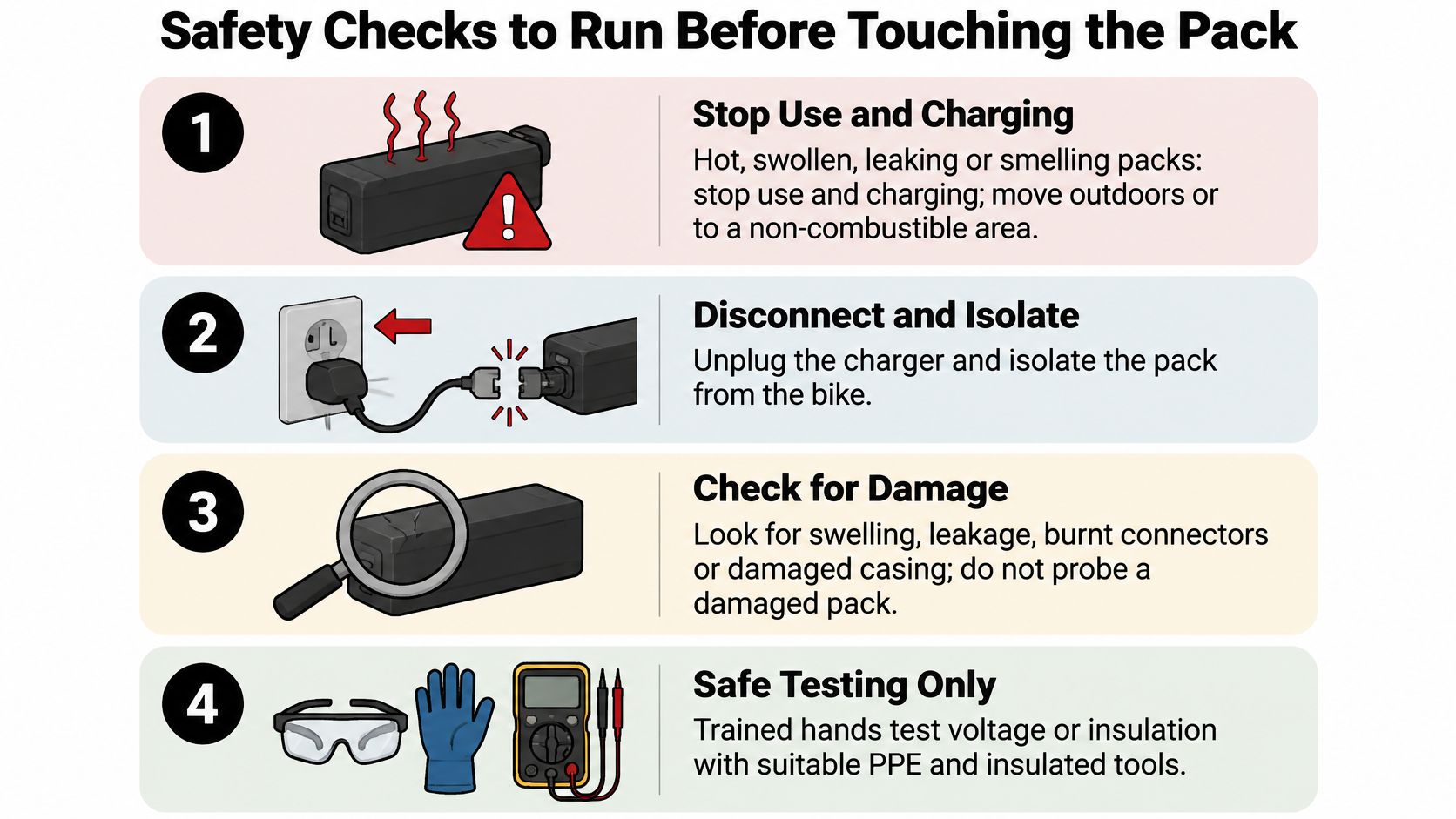
- Stop using and charging anything hot, swollen, leaking or smelling. Move the pack outdoors or onto a non-combustible surface such as a concrete slab, away from the house and away from anything that burns. A failing cell doesn't need a flame to start a fire, only heat and time, so the priority is putting distance between the pack and your living room.
- Inspect the outside, not the inside. Look at the case, terminals, wiring and connector for cracks, scorch marks, bulges and corrosion. Those marks are evidence of physical damage that another charge cycle will make worse, and they're the cheapest diagnosis you'll ever get.
- Check the charger before you blame the pack. Use only the original unit, and inspect its lead and casing for damage. A substitute charger with the right plug but the wrong cut-off voltage is one of the most common causes of a pack overheating, and swapping chargers between bikes is how it happens.
- Watch the first charge closely. Stay nearby, listen for unusual noise, look for smoke or a change in the charger's light, and unplug as soon as the pack is full rather than leaving it on overnight. WorkSafe advises charging away from the main dwelling where practicable, so a garage or a shed beats a bedroom every time.
- Write down the pack's history. Drops, crashes, water exposure, age, and any previous repair all change the risk profile, and a technician who knows the pack was submerged last winter will test differently.
- Quarantine anything suspect. Label it, place it on a non-combustible surface clear of flammables, and speak to a qualified specialist before you attempt any diagnosis at all. A quarantined pack can sit safely for a week. An opened one can't.
What safe to continue looks like: an intact case, an undamaged connector, the original charger bringing the pack up without heat, no odour at any point, and a full charge that finishes and shuts off cleanly. If any one of those is missing, the pack hasn't been cleared. It just hasn't failed obviously yet.
What Owners Must Not Do Themselves
Owner checks stop at the outside of the pack. These seven actions belong to a qualified technician every time, because each one turns a contained fault into an uncontrolled one.
- Don't open a sealed pack. Cutting the case or prying the cover puts you next to live cells with no protection between you and them.
- Don't swap, add or solder cells. Mismatched chemistry, capacity or voltage restarts exactly the fault you were trying to fix, and the damage shows up months later.
- Don't dry a wet pack with heat. A hair dryer or a warm oven can supply the heat that pushes a damp cell into failure. Moisture needs assessment, not evaporation.
- Don't bypass, reset or reflash the management system. That board is what stands between the cells and an overcharge or a short circuit, and disabling it removes the only guard in the pack.
- Don't charge a swollen, cracked, hot or wet pack. Charging is the highest-risk moment in a pack's day, and it's the wrong time to test whether a fault has settled down.
- Don't fit a substitute charger. A plug that fits isn't a charger that matches, and voltage and cut-off mismatches can damage packs without warning.
- Don't post, courier or bin a damaged pack. No carrier moves a damaged battery without the receiving facility's approval, and household rubbish is never an option.
A repair begins only after a qualified technician has isolated the pack and confirmed the fault. Everything before that is inspection.
Why Battery Repair Is a Specialist Job
The national record has been climbing for a while. A Fire and Emergency New Zealand-commissioned BRANZ report published in January 2020 found that lithium-battery incidents recorded by Energy Safety New Zealand rose from virtually zero in 2009 to more than 20 in 2019, and projected approximately 80 incidents by 2025, as the BRANZ lithium battery report sets out. That same report warned its figures were incomplete because fire records didn't consistently identify battery involvement, so read the number as a floor rather than a total.
How thermal runaway starts
Thermal runaway is a chain reaction inside the pack. One cell overheats, whether from an internal short, physical damage, overcharge or a bad connection, and the heat it releases pushes the cells beside it past their own threshold. Those cells heat the next ones. A single failed cell becomes a fire that runs the length of the pack and carries toxic smoke with it. Picture one hot log in a stack that's already warm: the fire doesn't stay where it started.
A pack is a system, not a box of batteries. Cells, management board and enclosure have to work together, and a repair that disturbs one part creates a new fault somewhere else. Cells of mismatched age sit in the same series string and stop sharing load evenly. A protection board that no longer suits the series layout stops balancing properly. A case that no longer seals lets moisture in behind the cells.
Take a rebuilt pack assembled from mixed-age cells. Fresh cells and older ones share one string, so the fresh ones carry a different share of the load through every discharge. The management system balances what it can, but a weaker group drifts out of step and the charger keeps pushing current into a string that's already full. Nothing looks wrong for months. Then one group runs hotter than its neighbours on every charge, and the case becomes warm to the touch in a way it never was before.
That is why the Fire and Emergency New Zealand position is that repairs and battery replacements belong with qualified professionals, and why the practical checks are inspection, testing, correct chargers, compatible management systems and safe isolation of damaged packs.
Repair is a safety task first and a performance task second.
If the diagnosis has moved past what a home check can settle, the next step is a workshop with real battery experience. Our guide to electric bike repair near me covers what that service should include.
What a Qualified Repairer Checks Before Returning a Pack
A repaired pack goes back on a bike only after a technician has signed off a sequence, not because it seemed fine on the bench.
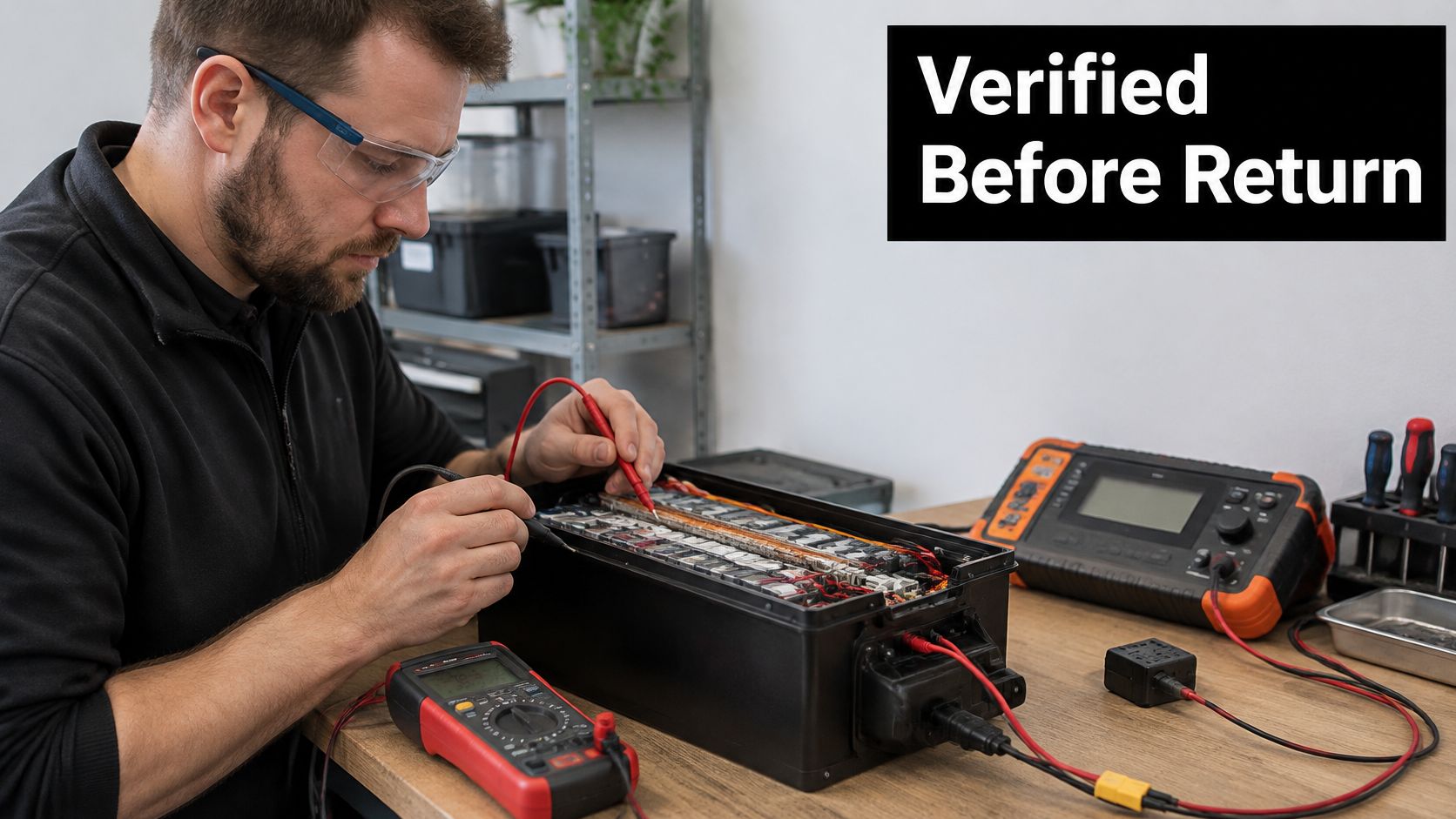
The regulatory frame matters here. WorkSafe's medium-risk product list identifies lithium-ion and lithium-polymer batteries, along with power supplies and chargers, as declared electrical articles. The same page records a New Zealand house fire believed to have involved an electrical malfunction while lithium-ion scooter batteries were charging. A charger and a pack are safety-relevant products, not accessories, and a repair should be controlled accordingly.
The verification sequence
- Polarity. Reversed connections destroy electronics and can weld a connector shut.
- Insulation resistance. A pack that leaks current through its own casing is a shock and fire risk regardless of capacity.
- Connector integrity. Terminals are checked for pitting, heat marks and corrosion, because a high-resistance joint overheats under load.
- Cell voltage balance. Groups more than a small margin apart tell you the pack isn't finished, whatever the display says.
- A capacity test. Real watt-hours delivered, measured rather than estimated, is the only honest answer to "is this fixed".
- Management-system function. Charge cut-off, low-voltage protection and temperature behaviour all get confirmed, not assumed.
- Enclosure seal. A pack that goes back on a wet commuter bike has to keep water out of the cells.
Cells must match on chemistry, nominal voltage, capacity, maximum continuous current, physical format and protection requirements, and the management board has to suit the pack's series configuration and the charger feeding it. A pack with an unknown cell history, an altered protection board, heat-damaged wiring or a non-original charger should be rejected or referred to a battery specialist rather than handed back to a customer.
Here's the kind of shop-floor inspection those checks look like in practice.
When you're choosing who does the work, ask five questions: which cells are fitted and how they were matched, what capacity test was run and what result it returned, whether charger compatibility was checked, what warranty covers the repair, and what happens to the damaged pack if it isn't repairable. A workshop that answers all five without hedging knows what it's doing.
After the repair, the first charge happens in a clear, non-combustible area with someone actively watching it. WorkSafe advises against charging near flammable materials, on a bed or couch, or while people are asleep or away, and a freshly rebuilt pack deserves exactly that treatment for its first few cycles.
Handling Damaged or End-of-Life Batteries in New Zealand
An undamaged pack at end of life
A worn-out e-bike battery should go to a battery-recycling drop-off point, but the route is not always obvious. In New Zealand, collection arrangements vary by council and recycler, so check what the receiving facility accepts before loading the bike or pack into the car. Fire and Emergency New Zealand's lithium-ion battery safety resources are useful background for safe handling around lithium-ion batteries.
Before ringing around, read the label and note the chemistry, voltage and any visible damage. Our overview of electric bike batteries explains common configurations, which helps you describe the pack accurately. If you want a sense of how another small market presents collection and handling rules, Myhalo's guide to lithium battery safety in Singapore covers the same practical issue from a different setting.
A damaged, swollen or hot pack
A damaged pack is a different job from a tired but intact pack. A swollen, punctured, wet or scorched battery can be unsafe during storage or transport, so arrange the drop-off before you travel. Ask the council, retailer or specialist recycler whether they will accept it, whether terminals should be covered, and what covering material they want used. Do not post or courier a damaged pack without approval. Taping terminals is a facility instruction, not a default trick.
- Never in household rubbish. That is a hard rule, not a preference.
- Ring first, drive second. Ask whether they will take a damaged e-bike pack that day.
- Describe it clearly. Swollen, leaking, wet and scorched each change the answer.
- Keep it isolated until collection. Put it on concrete, clear of anything that burns.
The practical split is simple. An intact pack at end of life is a logistics problem: identify it, find an accepting facility and hand it over. A damaged pack is a risk-control problem: isolate it, get instruction and do not improvise transport. That distinction matters because a pack that looks merely old can still become dangerous if it has been knocked, soaked or charged with the wrong charger.
Do not strip cells, cut welds, open the case or try to "rescue" a swollen pack in a home workshop. Those jobs belong with a qualified professional who can test the cells, check the management system and decide whether the pack can be handled safely. If the answer is no, disposal through an approved route is the correct outcome.
Choosing Repair, Replacement or Disposal
Four routes exist, and the right one depends on what's wrong inside the case.
Repair, refurbishment, replacement and disposal compared
| Route | Suits | Main risk | Who does it |
|---|---|---|---|
| Cell or module replacement | One weak cell group with a sound case | Mismatched cells and battery-management imbalance | Qualified battery specialist |
| Refurbishment with new cells and matched management | Older pack with intact enclosure | Charger and protection mismatch | Specialist workshop |
| Manufacturer replacement pack | Swollen, cracked, water-damaged or unknown history | Cost and availability | Authorised dealer |
| Recycling or disposal | End-of-life or damaged pack beyond repair | Fire if mishandled in storage or transit | Council or approved recycler |
The common assumption is that replacing individual cells is automatically cheaper or safer than a new pack. It's neither, reliably. Management-system compatibility, enclosure integrity, charger matching, water resistance and cell matching all have to hold, and any one of them failing makes an apparently simple repair unsafe. A pack that comes back with fresh cells inside a tired case and an unmatched charger is a worse bet than a manufacturer replacement, because the fault that killed the original cells is still in the system.
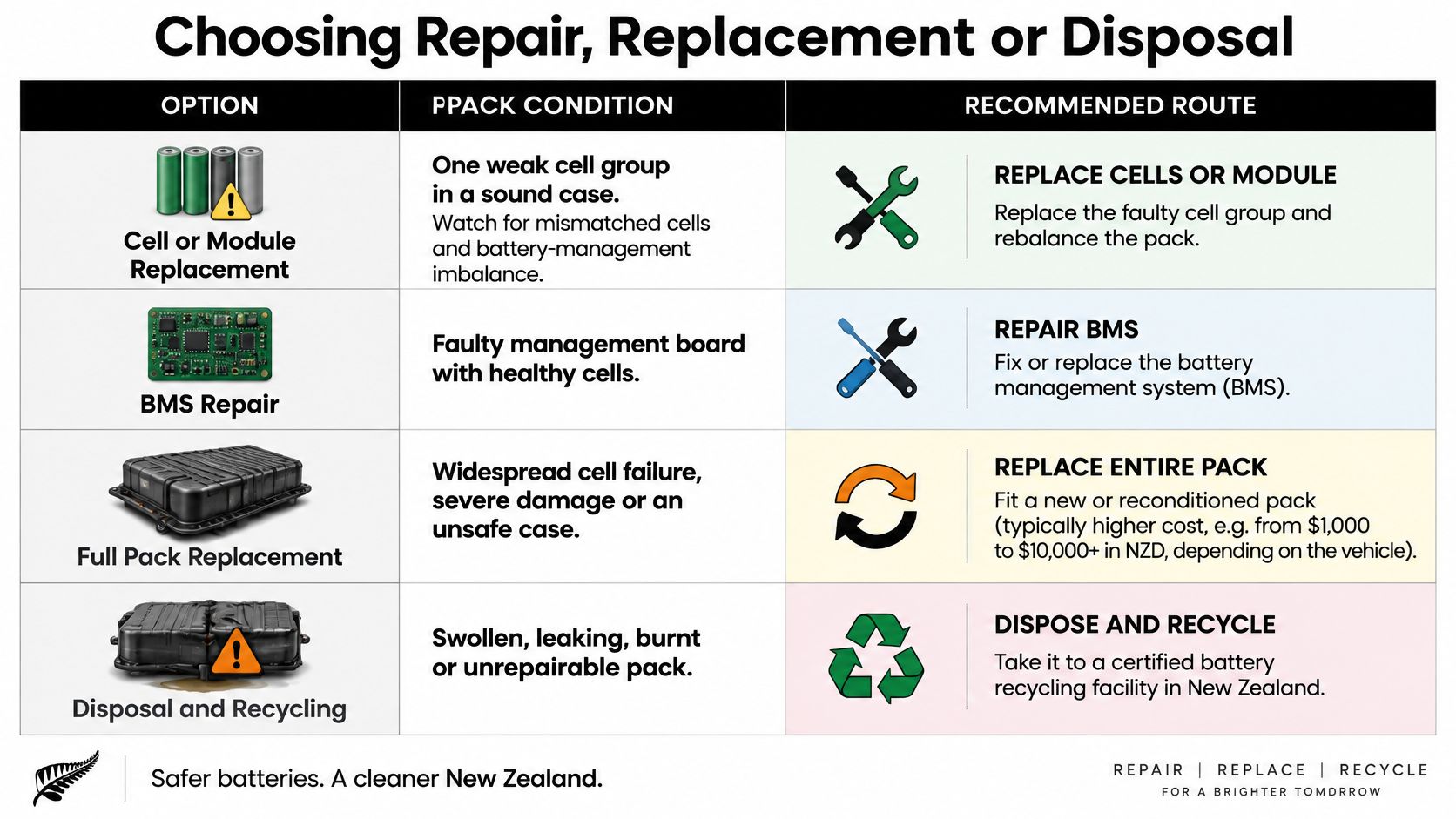
The decision rules are short. Repair when the case is intact, the fault is a connector or one weak cell group, and a workshop can verify the result on the bench. Replace when the case is sound but the pack has aged out, or when a manufacturer pack is the only properly matched option for your motor and display. Dispose through approved channels when the pack is swollen, cracked, hot or wet, and don't negotiate with that one. Fire and Emergency New Zealand's lithium-ion battery safety guidance is direct that swollen, cracked, punctured or abnormally hot packs shouldn't be opened, moved casually or put on charge, and that repairs and replacements belong with a qualified professional.
The same arithmetic applies to any battery, at any scale. A specialist repair only makes sense if the rest of the machine is worth keeping, and if you're weighing a pack against a whole vehicle, compare hybrid pack prices and repairs shows how those sums work at the larger end of the scale.
At the workshop end, a minor fault gets an E-Health Check at $59.00, which means plugging the bike into diagnostics, applying updates where required, checking the error log and components for wear, then a function check and a test ride. If a battery does need to leave the shop, e-bikes take 3 to 5 working days and travel with fully certified dangerous goods transport handling for battery compliance, so nothing gets couriered on a guess.
Three steps, then. Run the triage in order and stop at the first red flag. Match your symptom to the route rather than to the price. And book a qualified check before the next ride rather than after the next cut-out.
When a symptom in this article sounds like your own bike, a diagnostic session beats another round of guesswork. Rider 18's Nelson workshop plugs e-bikes into diagnostics, reads the error log, checks components for wear and finishes with a test ride, so you know whether your pack needs a capacity test, a connector repair or a replacement. Book that check before your next ride at Rider 18.


